Um desafio: a salvaguarda da unidade da família humana.

Há o risco real de que a família humana seja bifurcada, entre aqueles que se beneficiam dos avanços tecnológicos, da biotecnologia e nanotecnologia e dispõem de todos os meios possíveis de vida e de bem-estar, cerca de 1,6 bilhões de pessoas, podendo prolongar a vida até aos 120 anos que corresponde à idade possível das células. E a outra humanidade, os restantes mais de 5,4 bilhões, barbarizados, entregues à sua sorte, podendo viver, se tanto, até os 60-70 anos com as tecnologias convencionais num quadro perverso de pobreza, miséria e exclusão.

Esse fosso deriva do horror econômico que tomou a cena histórica sob a dominação do capital globalizado especialmente do especulativo sob a regência cruel do neoliberalismo radical. Considerando-se triunfante face ao socialismo real cuja derrocada se deu no final dos anos 80, exacerbou seus princípios como a competição,o individualismo, a privatização e a difamação de todo tipo de política e satanização do Estado, reduzido ao mínimo. Cerca de 200 megacorporações, cujo poder econômico equivale a 182 países, conduzem junto com os organismos da ordem capitalista como o FMI, o Banco Mundial e a Organização Mundial do Comércio a economia mundial sob o princípio da competição sem qualquer sentido de cooperação e de respeito ecológico da natureza. Tudo é feito mercadoria, do sexo à religião, numa volúpia de acumulação desenfreada de riquezas e serviços à custa da devastação da natureza e da precarização ilimitada dos postos de trabalho.

O risco consiste em que os muito ricos criem um mundo só para si, que rebaixem os direitos humanos a uma necessidade humana que deve ser atendida pelos mecanismos do mercado (portanto só tem direitos quem paga e não quem é simplesmente pessoa humana), que façam dos diferentes desiguais e dos desiguais dissemelhantes, aos quais se nega praticamente a pertença à espécie humana. São outra coisa, óleo gasto,zeros econômicos.

No Ocidente que hegemoniza o processo de globalização, a ideia de igualdade politicamente nunca triunfou. Ela ficou limitada ao discurso religioso-cristão, de conteúdo idialístico. Esse déficit de uma cultura igualitária impediria a bifurcação da família humana. Pode triunfar uma idade das trevas mundial que se abateria sobre toda a humanidade. Seria a volta da barbárie.

O desafio a ser enfrentado é fazer tudo para manter a unidade da família humana, habitando a mesma Casa Comum. Todos são Terra, filhos e filhas da Terra, para os cristãos, criados à imagem e semelhança do Criador, feitos irmãos e irmãs de Cristo e templos do Espírito. Todos têm direito de serem incluídos nesta Casa Comum e de participarem de seus dons.

Para dar corpo a este desafio precisamos de uma outra ética humanitária que implica resgatar os valores ligados à solidariedade, à empatia e à compaixão. Importa recordar que foi a solidariedade/cooperação que permitiu a nossos ancestrais, há alguns milhões de anos, darem o salto da animalidade à humanidade. Ao saírem para coletar alimentos, não os comiam individualmente como o fazem os animais. Antes, reuniam os frutos e a caça e os levavam para o grupo de co-iguais e os repartiam solidariamente entre todos. Deste gesto primordial nasceu a socialidade, a linguagem e a singularidade humana. Será hoje ainda a solidariedade irrestrita, a partir de baixo, a compaixão que se sensibiliza diante do sofrimento do outro e da Mãe Terra, que garantirão o caráter humano de nossa identidade e de nossas práticas. Foi o que vergonhosamente faltou aos grandes credores internacionais que face à tragédia do tsunami do sudeste da Ásia não perdoaram os 26 bilhões de dívidas daqueles países flagelados, Apenas protelaram por um ano, o seu pagamento.

Sem o gesto do bom samaritano que se verga sobre os caídos da estrada ou a vontade de infinita compaixão do bodhisatwa que renuncia penetrar no nirvana por amor à pessoa que sofre, ao animal quebrantado ou à árvore mirrada, dificilmente faremos frente à desumanidade cotidiana que está se naturalizando a nível brasileiro e mundial.

Na perspectiva dos astronautas, daqueles que tiveram o privilégio de ver a Terra de fora da Terra, Terra e Humanidade formam uma só entidade, complexa mas una. Ambas estão agora ameaçadas. Ambas possuem um mesmo destino comum e comparecem juntas diante do futuro. Sua salvaguarda constitui o conteúdo maior de um ancestral sonho: todos sentados à mesa, numa imensa comensalidade, desfrutando dos frutos da boa e generosa Mãe Terra.

Se o cristianismo e os demais caminhos espirituais não ajudarem a realizar esse sonho e não levarem as pessoas a concretizá-lo, não teremos cumprido a missão que o Criador nos reservou no conjunto dos seres, que é a de sermos o anjo bom e não o Satã da Terra. Nem teremos escutado e seguido Aquele que disse: “Vim trazer vida e vida em abundância”(Jo 10,10).

Importa conscientizarmo-nos de nossa responsabilidade, sabendo que nenhuma preocupação é mais fundamental do que cuidar da única Casa Comum que temos e de alcançar que toda a família humana, superando as contradições sempre existentes, possa viver unida dentro dela com um mínimo de cuidado, de solidariedade, de irmandade, de compaixão e de reverência que produzem a discreta felicidade pelo curto tempo que nos é concedido passar por esse pequeno, belo e radiante Planeta.

Uma utopia? Sim, mas necessária se quisermos sobreviver.

Leonardo Boff escreveu:Proteger a Terra- salvar a vida. Como escapar do fim do mundo, Record, Rio 2010.
How the Pan Amazon Synod could surprise us

The «Pan-Amazon Synod» is taking place in Rome from October 6th to the 27th. In 1974, Pope Paul VI instituted the concept of the Synod: first were the «Synod of Bishops», with representatives from every continent, and the «Regional Synods», such as the 1980 Synod of the Dutch Bishops and the Synod of the German Bishops, that is being celebrated in 2019, among others.

The Synod, that etymologically means “to make together (syn) the path (odos)” is an opportunity for local or regional churches to take the pulse of their ministries, analyzing problems, identifying challenges and seeking together ways to implement and realize the Gospel.

The Pan Amazon Synod has special relevance, for the twin levels of consciousness manifested in its basic theme: “New paths for the Church and for the integral Ecology”. It is about defining a new form of the Church’s presence in the American continent, particularly in the vast Amazon region that spreads over 9 countries, in an expanse of more than 8 million square kilometers. The other form of consciousness is seen in the importance of the Amazon to the Earth’s equilibrium and the future of life and humanity.

The Roman Catholic Church in the American continent and the Amazon region was a mirror of the mother-Church of Europe. After five centuries, it has transformed itself into a source-Church, with an Afro-Indigenous-European face. In his opening homily of the Synod, on October 4th, Pope Francis openly said: ”How many times has God’s gift been… not offered, but imposed! How many times has there been colonizing instead of evangelizing! May God save us from a new colonialism”.

On another occasion, in Puerto Maldonado, Peru, he asked for forgiveness–something never before done by a Pope–: ”I humbly ask for forgiveness” Francis said, “not only for the offenses committed by the Church herself, but for the crimes against the original peoples that took place during the conquest of the American continent”.

The «Instrument of Work» to prepare the Synod, asks that “viri probati”, this is, married men, proven to be honorable, especially indigenous men, be ordained priests. Dom Erwin Kräutler,Bishop Emeritus of Xingu, the largest diocese in the world, suggested to Pope Francis that in place of the term viri probati (honorable men) the term personae probatae (honorable persons), which would also include women, should be used. Dom Erwin says: in the communities women do everything that the priest does, except consecration of the bread and wine. Why not allow them this mission as well? Mary gave birth to Jesus, the Son of God; the women, her sisters, why cannot they represent him? Moreover, the text says that women will be given a special mission. It could be, as in all the other Christian Churches, that women too, in their own way, be priests.

This Pope is innovative and courageous. The best theologians say that neither dogma nor doctrine precludes women from representing Christ. Theologically speaking, the priest is not the one who consecrates. Christ does that. The priest only lends visibility to the act. At present, the only roadblock is the patriarchy.

The most important and acute question is safeguarding the Amazon biome. That vast region has been studied by the greatest scientists for at least two centuries. As Euclides da Cunha said in his Amazon essays:“Human intelligence could not support the weight of the portentous reality of the Amazon; human intelligence would have to grow with her, adapting to her, to dominate her” (Vozes 1976, p. 15). The Amazon is the world’s greatest filter. It captures carbon dioxide, returning oxygen to us, and mitigates global warming. Its biodiversity is such that “in few hectares of the Amazon jungle there exists a greater number of species of plants and insects than all the flora and fauna of Europe”, says the great specialist E. Salati.

But its most important meaning lies in the immensity of its waters, be they those of the flying rivers (the tremendous humidity of the trees, that rises above the jungles), the surface waters of the rivers, or the immense aquifer Alter do Chão. If we do not preserve the jungle, the Amazon will be turned into a desert, like the Sahara, that some 15 thousand years ago was like the Amazon, with the Nile river flowing into the Atlantic If the Amazon is deforested, fifty billion more tons of carbon dioxide annually would be released into the atmosphere, making life impossible in the South of the continent.

Pope Francis referred to the fate of the Amazon when analyzing the present global situation:“the Earth is ever more interconnected and the peoples that inhabit it are part of the planet’s community, for example, the problem of the fires in the Amazon is a problem not only for the Amazon region… is a world problem, as is the migratory problem”.

Awareness that the Amazon biome is a «Common Good of the Earth and of Humanity» is growing. The cry of each country’s sovereignty still exists in the old paradigm that divides up the planet… Today it is important to reunite those parts and recreate the reality that there is but one, a whole: the Common Home for us and for the entire «Community of Life»… Brazil does not own the Amazon (63%); Brazil is only its current administrator –under a new government– of a highly irresponsible form. It pays little attention to the fires and, when it deals with the minerals, the oil, and other wealth, it supports huge projects that threaten the Native peoples — those who know how to care for and to preserve the jungle– and the ecological equilibrium of the whole Common Home.

There is a project supported by scores of caciques, bishops. authorities, scientists and others that will be presented in the Synod, to declare “The Amazon, ¡intangible sanctuary of the Common Home!”.

UNESCO has already registered several biomes in many countries; why not do so with the Amazon, where the future of the Earth’s vitality and human civilization is at stake?

Leonardo Boff Eco-Theologian-Philosopher of the Earthcharter Commission

Free translation from the Spanish sent by
Melina Alfaro, alfaro_melina@yahoo.com.ar.
Done at REFUGIO DEL RIO GRANDE, Texas, EE.UU.

The neo-liberal project in the world and in Brazil is anti-life and the enemy of nature

I will address the reflections of one of our best philosophers, Manfredo de Oliveira, from the Federal University of Ceara, specialist in the relationship between the economy, society and ethics. His work on the topic is vast. We will summarize here a lengthy study on the project developed elsewhere, and now in Brazil: the ultra radical neo-liberalism.

de Oliveira writes:
«This project fundamentally consists of the radical extension of what is called “Economic Liberalism”. This theoretical economic current is known as the Chicago School. However, its philosophical foundations lie in the theses of the so called Austrian School, whose principal exponent is Ludwig von Mises. These are his basic theses: «the right of property is the only universal, fundamental and absolute right. It begins with the absolute right to one’s body and includes all the goods that can be acquired. From this right derives the absolute right of non aggression against one’s property and the right to defend that property».

«The State is seen as the great usurper of property. The only ethically acceptable institution in economic activity is the “Free Market”. Everyone in the free market has the same rights. Each individual is solely responsible for his objectives. Its rules constitute a mechanism similar to the laws of nature: they are objective, and humans cannot modify them. We must study human action as physics studies the laws of nature».

«In the same way that we cannot judge the law of gravity as good or bad, we cannot judge the laws of the market. There is no sense in positing ethical questions that belong on another level. Here the only question is its technical efficacy. The market is understood as a self organizing mechanism and as such it can be evaluated for its efficacy and not on an ethical basis».

«There are no rights other than the laws of the market. Consequently, inequality and exclusion have nothing to do with social injustice. Thus,poverty is not an ethical problem, but one of technical incompetence.The main error the opponents of capitalism commit is the accusation of social injustice, based on the idea that “nature” gave all persons some rights simply for having been born». For this reason, in reference to the distribution of wealth… «it makes no sense to refer to a supposed natural or divine principle of justice» (Cf. Mises L. von, The Anti-Capitalist Mentality, Auburn, 2008, p. 80, 81).

«Tax is a form of confiscation of property. Consequently, neither health, education nor justice, are legitimate when financed by the State. The poor are individuals who by their own fault lost the competition with others. Thus, merit emerges as the only criterion of social promotion».

«That social project is frequently denominated by Pope Francis as “anti-life”, “assassin of the poor and of nature”. It purports to oppose the Social Well Being State (in Brazil, Democratic State of Rights). This adheres to the following elements along the line of J. M. Keynes: 1) Intervention by the State in the mechanisms of the market; 2) Politics of full employment (improving the performances of citizens); 3) Institutionalization of the system of protection; 4) Institutionalization of help for those left behind by the work market».

«The result of this process has been the increase of the capacity of consumption of the least favored classes».

«The fundamental objective now, in the new model of neo-liberal society, is to maximize the profits made by capital. That makes social rights tend to disappear, along with deregulation of the labor markets, and that the wealth of the wealthiest increases. Hence the global crusade against intervention by the state, and the social and economic rights created by the policies of the Social State, because they constitute an obstacle to the functioning of the laws of the competence, and for that reason are considered irrational and populist policies. In this form, the defenders of the “totally free market” oppose social policies, considered inefficient and disruptive of the productive process».

«The path now is to totally trust in the market as a self-organizing system that, once free from regulation and undue intervention, solves by itself the socio-economic problems».

«In this context it is seen that the basic axis of the project of civilization is now the subordination of human’s quality of life to the accumulation of capital».

«It is important, then, to recognize that the results of this process threaten human life and all life on the planet. The unlimited exploitation of nature is seen in the socio-environmental catastrophes. The most prestigious scientists warn us of the fact that the current economic model can lead humanity to an ecological and social collapse».

If Bolsonaro and Guedes accept this ultra-neo-liberal project, they will create a country with millions of poor and even pariahs, with a few rich and a handful of multimillionaires, a country that is not just poor but also unjust.

Leonardo Boff Eco-Theologian-Philosopher, of the Earthcharter Commission

Free translation from the Spanish sent by
Melina Alfaro, alfaro_melina@yahoo.com.ar.
Done at REFUGIO DEL RIO GRANDE, Texas, EE.UU.

“Amazônia, santuário intangível da Casa Comum”

Nestes tempos em que se está realizando em Roma o Sínodo Panamazônico, muitos grupos se manifestam e enviam suas petições ou comentários ao grupo central, responsável pela redação do documento final. Um desses, creio, dos mais impressionantes vem de grupos indígenas sul-americanos com mais de 400 subscrições de lideranças indígenas, de bispos e outros expertos do bioma amazônico. O texto chegou às mãos do Papa pelo bispo Dom Evaristo Spengler da ilha do Marajó que se notabilizou, anteriormente, por uma extraordinária intervenção na fase preparatória.Lboff

Este é o texto

               “Amazônia, santuário intangível da Casa Comum”

“Saudamos a realização do Sínodo Panamazônico, uma extraordinária iniciativa do Papa Francisco pela qual esta importante asembléia colegial pode ver a problemática, analizar e avaliar a realidade a luz da Palavra e desenhar propostas de ação. A iniciativa é um sinal de esperança no meio dos perigos que ameaçam a subsistência da Casa Comum.

Pedimos ao Papa Francisco e a todos os padres sinodais uma declaração da Amazônia como Santuario da Casa Común.

Esta declaratória seria um chamado espiritual e profético a todos os homens e mulheres de boa vontade para que se reconheça a Amazônia, que cobre 9 países, como terra santa, tão sagrada como a da sarça ardente de Moisés que escutou as palavras de Deus, “o lugar em que estás é terra santa”.

A declaratória seria um chamado à consciência universal e particularmente um pedido aos organismos mundiais e aos estados responsáveis para que tomem as medidas urgentes e profundas que se fazem necessárias para salvar a vida no planeta.

As medidas deveriam ser feitas e aplicadas com sentido de emergência, considerando a velocidade e a profundidade das mudanças adversas que vêm afetando cada vez mais o clima, o habitat e a vida dos povos amazônicos. Os objetivos devem enfocar o problema como um todo, pois tudo é afetado sistematicamente. A flora é impactada e a fauna, o clima, o ar, e o regime de chuvas, comprometendo o delicado equilíbrio de todos os ecossistemas e mesmo a vida dos povos amazônicos, cujo extermínio está cada vez mais próximo. Os povos não são uma espécie a mais do sistema. São uma obra magnífica de Deus, sua imagem e semelhança. Eles receberam do Criador esse paraíso natural, o desfrutam e o protegem. Sabendo-se e sentindo-se um com seu mundo, sabem como viver sem afetar seu equilíbrio.

Consequentemente as medidas deveriam ser assim implementadas.

1.Que se determinem legalmente os territórios suficientes para cada uma das diversas nacionalidades indígenas que habitam na Amazônia, considerando sua forma de viver e de interagir com a natureza.

2.Que a delimitação e a localização dos territórios seja tal que cada um constitua um refúgio seguro e a base de sustento e nutrição dos povos indígenas e a vida da Amazônia.

Que se aplique a estes territórios uma significativa moratória das atividades extrativistas que prejudicam a floresta, também das petroleiras e das mineradoras. Da mesma forma se discuta seriamente a implementação de plantações e de criação de gado que implicam desflorestação. Especialmente que se garanta a sustentabilidade para uma eventual abertura de estradas e de centrais hidrelétricas. Em fim, que cessem as intervenções predatórias tanto por parte dos governos quanto dos grupos econômicos interessados, nacionais e internacionais.
Que os povos indígenas possam exercer nestes territórios sua autoridade, no marco da autodeterminação, do autogoverno, da justiça ancestral de acordo com os usos e costumes e sua vida política, cultural e espiritual em plenitude, sentido-se parte da nação.
Os acordos e pactos internacionais ficaram sem eficácia porque não são obrigatórios para os países. Não se estabeleceram consequências para a sua não implementação. Aspiramos que o Sínodo possa demandar aos organismos internacionais para que peçam a aplicação efetiva e eficaz das resoluções tomadas.

Pedimos aos padres sinodais que atuem com energia para pedir que os estados que se comprometeram com seus compromissos em favor da Amazônia mediante a adoção de mecanismos idôneos, independentes do vai- e- vem das conjunturas políticas.

Desta forma, a Declaratória de Santuário, será um instrumento idôneo para salvaguardar os povos indígenas em isolamento voluntário. Eles constituem grupos humanos mais vulneráveis da Amazônia e do mundo, vítimas da violência do modelo econômico global, depredador, imposto. Ao mesmo tempo comparecem como um testemunho de resistência a esta globocolonização que uniformiza e mata a diversidade e a vida da humanidade e do planeta.

“Para o indígena, a terra é mãe. Não se trata de uma maneira de falar, não é um puro sentimentalismo. O povo indígena considera, dentro de seu núcleo cultural, dentro de seu pensamento, a terra como sua mãe… pensamento que, por outra parte, se identifica com o pensamento das Sagradas Escrituras, em outras palavras, com o pensamento de Deus”(Dom Leônidas Proaño, bispo de Riobamba, Equador). E acrescenta ainda o Papa Francisco em sua encíclica Laudato Si sobre o cuidado da Casa Comum. “Para os indígenas a Terra não é um bem econômico, senão é um dom de Deus e de seus antepassados que descansam nela, um espaço sagrado pois o nessecitam para interagir e para sustentar sua identidade e seus valores; quando permanecem em seus territórios, são precisamente eles que melhor os cuidam”(n.146).

Queremos finalizar com as palavras de Bernardo Alves, do povo indígena Sateré-Mawé. “Os povos indígenas são bibliotecas vivas. São guardiães, cuidadores e jardineiros da Amazônia e do planeta. Cada vez que um povo indígena é exterminado ou desaparece, um rosto de Tupãna (Deus),morre e o cosmos, e o planeta e toda a humanidade se empobrecem”.

Articulação- Pueblo Indio del Ecuador, Quito.

e-mail fpie@fundaciónpuebloindio.org

Seguem mais de 400 subscrições de lídres indígenas, de muitos bispos, especialistas, militantes, missionários e missionárias e representantes de povos da floresta.


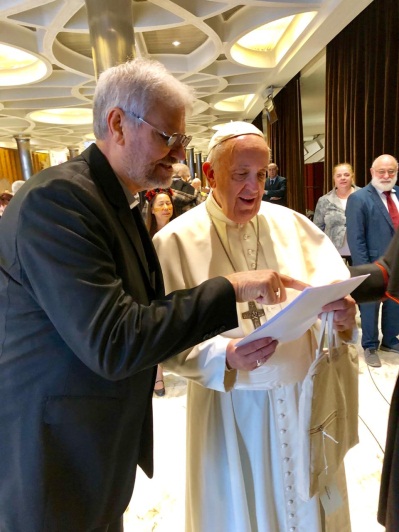
Dom Evaristo Spengler entregando ao Papa o Documento Amazônia Santuário intangível da Casa Comum