Leonardo Boff
We are still in 2021, a year that did not end because Covid-19 canceled the count of time to continue its lethal work. The 2022 could not, for now, be inaugurated. The fact is that the virus has brought all powers to their knees, especially the militarists, as their arsenal of death has become totally ineffective. However, the genius of capitalism, apropos of the pandemic, made the transnationalized capitalist class restructure itself through the Great Reset, expanding the recent digital economy through the integration of the giants: Microsoft, Facebook, Apple, Amazon , Google, Zoom and others with the military-industrial-security complex. Such an event represents the formation of an immense power, never before seen.
Note that this is an economic power of a capitalist nature and that, therefore, it fulfills its essential purpose, that of maximizing profits in an unlimited way, without regard to exploiting human beings and nature. Accumulation is not a means to a good life, but an end in itself, that is, accumulation for the sake of accumulation, which is irrational. The consequence of this radicalization of capitalism confirms what a sociologist at the University of California at Santa Barbara, William I. Robinson, in a recent article, well observed (ALAI 12/20/2021): “As the world gets rid of pandemic, there will be more inequality, conflicts, militarism and authoritarianism and to the same extent social upheavals and civil conflicts will increase; ruling groups will strive to expand the global police state to contain mass malcontents from below”.
Indeed, artificial intelligence with its billions and billions of algorithms will be used to control each person and the entire society. Where will this brutal power take humanity? Knowing the inexorable logic of the capitalist system, Max Weber, one of those who best analyzed it critically, just before he died, asserted: “What awaits us is not the flowering of autumn, but a polar night, icy, dark and arduous. (Le Savant et le Politique, Paris 1990, p. 194).
He coined the strong expression that strikes at the heart of capitalism: it is an “iron cage” (Stahlartes Gehäuse) that cannot break and, therefore, can lead us to a great catastrophe (cf. the pertinent analysis by M.Löwy , La jaula de hierro: Max Weber and the Weberian Marxism, Mexico 2017). This opinion is shared by great names such as Thomas Man, Oswald Spengler, Ferdinand Tönnies, Eric Hobsbown, among others. Several world-society models are being discussed for the post-pandemic period.
The most important ones, besides the Great Reset of the billiards, are: green capitalism, ecosocialism, the bien viver and coexistence of the Andeans, biocivilization, of various groups and of Pope Francis among others.
This is not the place to detail such projects, which I did in the book Cvid-19: Mother Earth counterattacks Humanity (Voices 2020). I would just say: either we change the paradigm of production, consumption, coexistence and, especially, our relationship with nature, with respect and care, feeling that we are part of it and not about it as owners and masters, or else to fulfill ourselves.
Max Weber’s prognosis will be: from 2030 to 2050 at most, we will experience an ecological-social armageddon that is extremely harmful to life and to the Earth. In this sense, my feeling for the world tells me that whoever is going to destroy the order of capital, with its economy, politics and culture, would be no moment or school of critical thought.
It would be Earth itself, a limited planet that no longer supports a project of unlimited growth. The visible climate change, object of discussion and decision-making (practically none) of the last UN COPs, the growing depletion of natural goods and services, fundamental for life (The Earth Overshoot) and the threat of disruption of the main nine barriers to development that cannot be broken at the price of civilization’s collapse.
A significant number of climate experts say we are too late. With the already accumulated greenhouse gases we will not be able to contain the catastrophe, only, with science and technology, to lessen its disastrous effects. But the great irreversible crisis will come. That’s why they became skeptics and even technofatalists. Are we resigned pessimists or, in Nietzsche’s sense, adherents of “heroic resignation”? I believe, as a pre-Socratic said: we must expect the unexpected, because if we don’t expect it, when it comes, we won’t notice it. The unexpected can occur, within the quantum perspective: the current suffering because of the systemic crisis will not be in vain; he is accumulating benevolent energies which, upon reaching a certain level of complexity and accumulation, will make a leap to another higher order with a new horizon of hope for life and for the living planet, Gaia, Mother Earth. Paulo Freire coined the expression to hope: not to wait for the situation to improve one day, but to create the conditions so that hope is not empty, but that, with our commitment, we make it effective. I believe that this leap, with our participation, could occur and would be within the possibilities of the history of the universe and the Earth: from the current destructive chaos, we can move to a generative chaos of a new way of being and inhabiting planet Earth. This is what I believe and hope, reinforced by the word of Revelation that says: “God created all things out of love because he is the passionate lover of life” (Wisdom 11:26). He will not allow us to end this tragically. We will still live in the benevolent light of the sun.
Leonardo Boff, ecotheologist, philosopher and writer. Wrote The painful birth of Mother Earth: a society of fraternity without borders and social friendship, Vozes 2021; Inhabiting the Earth: What is the path to universal brotherhood? Voices 2121.
s the formation of an immense power, never before seen.
Note that this is an economic power of a capitalist nature and that, therefore, it fulfills its essential purpose, that of maximizing profits in an unlimited way, without regard to exploiting human beings and nature. Accumulation is not a means to a good life, but an end in itself, that is, accumulation for the sake of accumulation, which is irrational. The consequence of this radicalization of capitalism confirms what a sociologist at the University of California at Santa Barbara, William I. Robinson, in a recent article, well observed (ALAI 12/20/2021): “As the world gets rid of pandemic, there will be more inequality, conflicts, militarism and authoritarianism and to the same extent social upheavals and civil conflicts will increase; ruling groups will strive to expand the global police state to contain mass malcontents from below”.
Indeed, artificial intelligence with its billions and billions of algorithms will be used to control each person and the entire society. Where will this brutal power take humanity? Knowing the inexorable logic of the capitalist system, Max Weber, one of those who best analyzed it critically, just before he died, asserted: “What awaits us is not the flowering of autumn, but a polar night, icy, dark and arduous. (Le Savant et le Politique, Paris 1990, p. 194).
He coined the strong expression that strikes at the heart of capitalism: it is an “iron cage” (Stahlartes Gehäuse) that cannot break and, therefore, can lead us to a great catastrophe (cf. the pertinent analysis by M.Löwy , La jaula de hierro: Max Weber and the Weberian Marxism, Mexico 2017). This opinion is shared by great names such as Thomas Man, Oswald Spengler, Ferdinand Tönnies, Eric Hobsbown, among others. Several world-society models are being discussed for the post-pandemic period.
The most important ones, besides the Great Reset of the billiards, are: green capitalism, ecosocialism, the bien viver and coexistence of the Andeans, biocivilization, of various groups and of Pope Francis among others.
This is not the place to detail such projects, which I did in the book Cvid-19: Mother Earth counterattacks Humanity (Voices 2020). I would just say: either we change the paradigm of production, consumption, coexistence and, especially, our relationship with nature, with respect and care, feeling that we are part of it and not about it as owners and masters, or else to fulfill ourselves.
Max Weber’s prognosis will be: from 2030 to 2050 at most, we will experience an ecological-social armageddon that is extremely harmful to life and to the Earth. In this sense, my feeling for the world tells me that whoever is going to destroy the order of capital, with its economy, politics and culture, would be no moment or school of critical thought.
It would be Earth itself, a limited planet that no longer supports a project of unlimited growth. The visible climate change, object of discussion and decision-making (practically none) of the last UN COPs, the growing depletion of natural goods and services, fundamental for life (The Earth Overshoot) and the threat of disruption of the main nine barriers to development that cannot be broken at the price of civilization’s collapse.
A significant number of climate experts say we are too late. With the already accumulated greenhouse gases we will not be able to contain the catastrophe, only, with science and technology, to lessen its disastrous effects. But the great irreversible crisis will come. That’s why they became skeptics and even technofatalists. Are we resigned pessimists or, in Nietzsche’s sense, adherents of “heroic resignation”? I believe, as a pre-Socratic said: we must expect the unexpected, because if we don’t expect it, when it comes, we won’t notice it. The unexpected can occur, within the quantum perspective: the current suffering because of the systemic crisis will not be in vain; he is accumulating benevolent energies which, upon reaching a certain level of complexity and accumulation, will make a leap to another higher order with a new horizon of hope for life and for the living planet, Gaia, Mother Earth. Paulo Freire coined the expression to hope: not to wait for the situation to improve one day, but to create the conditions so that hope is not empty, but that, with our commitment, we make it effective. I believe that this leap, with our participation, could occur and would be within the possibilities of the history of the universe and the Earth: from the current destructive chaos, we can move to a generative chaos of a new way of being and inhabiting planet Earth. This is what I believe and hope, reinforced by the word of Revelation that says: “God created all things out of love because he is the passionate lover of life” (Wisdom 11:26). He will not allow us to end this tragically. We will still live in the benevolent light of the sun.
Leonardo Boff, ecotheologist, philosopher and writer. Wrote The painful birth of Mother Earth: a society of fraternity without borders and social friendship, Vozes 2021; Inhabiting the Earth: What is the path to universal brotherhood? Voices 2121.

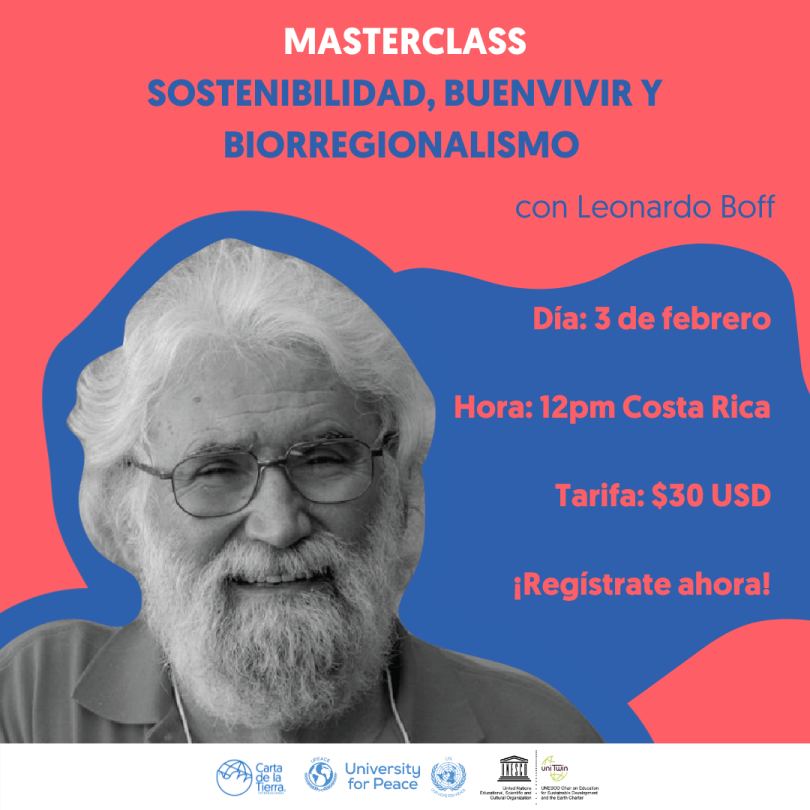
 Leonardo Boff