Frei Betto: a international Call against the Bolsonaro’s humanitarian crimes

                                LETTER TO OUR FRIENDS ABROAD

Frei Betto

Dear Friends,

A genocide is taking place in Brazil!  As I write, on 16 July 2020, COVID-19, first detected here in February this year, has already killed 76,000 people.  There are already almost two million people affected.  By Sunday 19 July we shall reach a total of 80,000 fatalities. It is possible that when you read this dramatic appeal, we shall already have reached 100,000.

When I think that in the Vietnam war, over twenty years, 58,000 lives of US-American military personnel were sacrificed, I grasp the scale and seriousness of what is taking place in my country.  This horror causes anger and revulsion. And we all know that precautionary and restrictive measures that have been adopted in so many other countries could have avoided slaughter on such a scale.

This genocide is not the result of the Bolsonaro government’s indifference.  It is intentional. Bolsonaro delights in the deaths of others.  When he was a member of Congress, he said in a TV interview in 1999: ‘Voting won’t change anything in this country, nothing, absolutely nothing! Change will only come, unfortunately, if one day we engage in a civil war here in Brazil, and do the work the military regime didn’t do:  kill 30,000.’

When he voted for the impeachment of President Dilma Rousseff, he dedicated his vote to the memory of the Brazilian army’s most notorious torturer, Colonel Brilhante Ustra.

Because of this great obsession with death, one of his main government policies is allowing the sale of weapons and ammunition.  When asked at the entrance to the presidential palace if he wasn’t concerned about the victims of the pandemic, he replied, ‘I don’t believe in these figures (27 March, 92 deaths);  ‘We’re all going to die one day’ (29 March, 136 deaths); ‘So what? What do you want me to do?’ (28 April, 5,017 deaths).

Why this necrophiliac policy? From the beginning he stated that the important thing was not to save lives, but to save the economy. That is why he refuses to order a lockdown, follow the guidance of the World Health Organisation and import respirators and personal protection equipment. The Supreme Court had to delegate this responsibility to state governors and city mayors.

Bolsonaro did not even respect the authority of his own ministers of health.  Since February Brazil has had two, both sacked for refusing to take the same attitude as the President.  Now the ministry is headed by General Pazuello, who has no knowledge of health matters; he had tried to hide the data about the increasing numbers of victims; he has employed 1.249 military personnel in important posts in the ministry, without the necessary qualifications; and he has cancelled the daily interviews from which the population received guidance.

It would take too long to list all the measures to release resources to aid low-income victims and families (over 100 million Brazilians) that were never taken.

The reasons behind the criminal decisions of the Bolsonaro government are clear.  Letting the elderly die saves the resources of the Department of National Insurance.  Letting those with pre-existing conditions die saves the resources of the national health service, the SUS.  Letting the poor die saves the resources of the Family Welfare programme and other social programmes targeting the 52.5 million Brazilians who live in poverty and the 13.5 million that live in extreme poverty (Federal government figures).

Not satisfied with such lethal measures, now, on 3 July the President has vetoed the section of a law that made obligatory the use of masks in shops, places of worship and educational institutions. He has also vetoed the imposition of fines on those who failed to keep the rules and the government’s obligation to distribute masks to the poorest sections of the population, the main victims of COVID-19, and prisoners (750,000). These vetoes, however, do not overturn local legislation that has already made the use of masks obligatory.

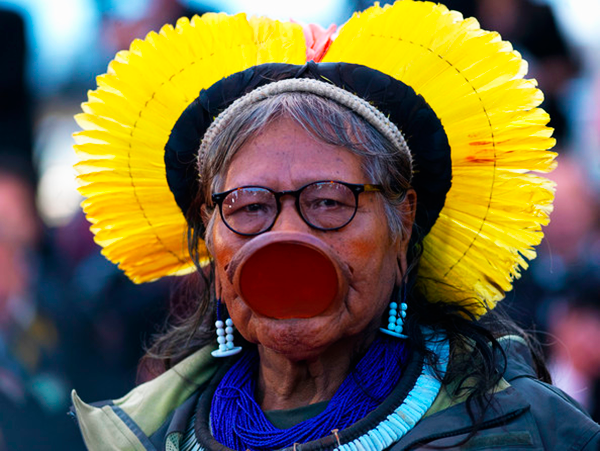
On 8 July Bolsonaro overturned three sections of a law approved by the Senate, that obliged the government to supply drinking water and health and cleaning materials, to install internet connections and distribute basic food supplies, seeds and agricultural implements to indigenous villages. He also vetoed emergency funds intended for indigenous health services, and to give indigenous and members of Afro-Brazilian ex-slave quilombola communities emergency aid of R$600 (120 Euros or US$120) for three months. He also vetoed the obligation on the government to provide more hospital beds, ventilators and oxygenation machines to indigenous and ex-slave communities.

Indigenous and ex-slave communities have been decimated by the increasing socio-environmental devastation, especially in the Amazon region.

Please give as much publicity as possible to this crime against humanity.  Condemnation of what is happening in Brazil must reach your country’s media, social networks,  the UN Human Rights Council in Geneva, and the banks and companies that represent the investors the Bolsonaro government so greedily wants.

Long before The Economist did so, on social media I have been calling the President BolsoNero – while Rome burned he played the fiddle and promoted hydrochloroquine, a drug scientifically shown to have no effect on the new coronavirus.  But its manufacturers are political allies of the President…

Thank you for your solidarity in publicising this letter.  Only pressure from abroad can halt the genocide that is devastating our dear, wonderful Brazil.

Yours fraternally

Frei Betto


Frei Betto is a Dominican brother and writer, an adviser to the FAO and to social movements.
 

Post-covid-19: what cosmology and ethics to incorporate (II)

Many analysts predict that the post-pandemic could usher in an extreme radicalization of the previous situation, a return to the system of capital and neo-liberalism, which seeks to dominate the world through electronic surveillance (big data) of every person in the planet, which is already being done in China and the United States. We then would enter an era of darkness, risking our own destruction, as suggested by Rachel Carson in her famous book, “Silent Spring”. Hence the demand for a radical ecological conversion, whose centrality must consist of the Earth, life and human civilization: a bio-civilization.

               The possible risks in the post-covid-19 period:

We must not, however, underestimate the power of systemic violence. Sigmund Freud, replying to a 1932 letter by Albert Einstein in which Einstein asked if it was possible to overcome violence and war, left an aporia. Freud replied that he could not say which tendency would prevail: the instinct of death (Thanatos) or the instinct of life (Eros). They are always in tension and we cannot be sure which will triumph in the end. And he concluded, resigned: “Starving, we think of the windmill that grinds so slowly that we can die of hunger before we get the flour”.

There is the non optimistic opinion of Noam Chomsky, one of the greatest Northamerican intellectuals and a severe critic of the imperialist system, who says: «The coronavirus is very grave indeed, but it is worth remembering that something even more terrible is near. We are headed towards disaster, something worse than anything that has ever happened in human history, and Trump and his lackeys are leading us towards the abyss. We are facing two immense threats. One is the ever growing threat of nuclear war, exacerbated by the tension of the military regimes; and the other, of course, is global warming. The two threats could be resolved, but there is not enough time; the coronavirus is terrible and can have terrible consequences, but it will be overcome, while the others will not. If we do not resolve them, we are condemned».

Chomsky has affirmed that President Trump is insane enough as to unleash a nuclear war, without caring what would happen to all of humanity.

Notwithstanding this dramatic vision of the prestigious linguist and thinker, our hope is that if humanity were to run a truly grave danger of self destruction, the life instinct would prevail. But that presumes that we had constructed a new form of inhabiting the Common Home, on bases that are neither those of the past, nor of the present.

         Some good lessons from the Covid-19 pandemic

In any event, the coronavirus has shown us that we are not the “little gods” who claim to be able to do anything; it has shown us that we are fragile and limited; that the accumulation of material goods does not save life; that financial globalization alone, in the competitive mold of capitalism, precludes the creation, as the Chinese propose, of “a community of common destiny for the whole humanity”; that we must create a global a pluralistic center to discuss world problems; that cooperation and solidarity of one an all rather than individualism are the central values of a geosociety.

The limits of the Earth-System which does not tolerate a project of unlimited growth must be recognized and respected; we must take as good care of nature as of ourselves, because we are part of nature and she gives us all the goods and services needed for life. We must seek a circular economy that fulfills the famous “3-Rs”; reduce, reuse, and recycle everything that has entered into the process of production.

The economy must be one of dignified and universal subsistence and not of accumulation by some at the expense of everyone else and of nature. An economy of subsistence reduces our needs and leads to sobriety, and thus in great measure reduces social inequalities. The new economic order will not be ruled by profit but by economic rationality with ecological and social sensitivity.

It would be highly rational and humanitarian to create a minimum universal income; for medical attention to be a universal human right (One World-One Health) that should not be left unattended. It is important to ensure that the state regulates the market, to promote the necessary development and satisfy collective demands, be they of health or natural disasters.

We must encourage human-spiritual capital, always unlimited, based on love, solidarity, the search for the just measure, fraternity, compassion, feeling the enchantment of the world and the tireless search for peace.

              A road map to rescue life: The Earthcharter

These are, among others, some of the lessons we can draw from the coronavirus. Quoting the Earthcharter, (UNESCO), one of the most inspiring official documents for the transformation of our form of being on planet Earth, «fundamental changes are needed in our values, institutions and forms of life… Our environmental, economic, political, social and spiritual challenges are interconnected and together we can forge inclusive solutions» (Preamble c).

What world vision and which values should be included?

To know and have knowledge of information about reality is not yet to act. What moves us to act? What world vision (cosmology) and which values (ethics) we should include? An important text in the final part of the Earthcharter, in whose editing I also took part, can guide us.

“As never before in history, the common destiny calls us to search for a new beginning. This requires a change of mind and heart. It demands a new sense of global interdependence and universal responsibility. We must develop and apply with imagination the vision of a mode of sustainable life at a local, national, regional and world levels” (The path ahead).

Let us note that it is not just about improving the path we have taken. This would lead us to the cyclical crises that we already know, and eventually to disaster. It is about “searching for a new beginning”. We are called to rebuild the “Earth, our home, that is alive with a unique community of life” (Earthcharter, Preamble a). It would be deceitful to cover the wounds of the Earth with bandages, thinking that we could cure her that way. We must revive her and remake her so that she may be our Common Home.

“This requires a change of mind”. A change of mind means a new way of looking at the Earth, according to the new cosmology and biology. She is at a moment of the process of evolution that is 13.7 billion years old, and for the Earth, 4.3 billion years. After the big bang, all the physical-chemical elements were forged over more than three billion years, in the heart of the big red stars. On exploding, they launched in every direction the elements that formed the galaxies, the stars like the Sun, the planets and the Earth.

The Earth is teeming with life that began some 3.8 billion years ago, a continuously self creating and self organizing systemic super-organism. In an advanced moment of her complexity, some 8-10 million years ago, a part of the Earth began to feel, to think, to love and to worship. The human being emerged, man and woman. They are Earth, conscious and intelligent, that’s why they are called homo, made of humus.

This cosmovision changes our conception of the Earth. The UN, on April 22, 2009, officially recognized her as Mother Earth, because she creates and gives us everything. This is why the Earthcharter calls us: “To respect the Earth and life in all its diversity and to take care of the community of life with understanding, compassion and love” (Earthcharter 1 and 2). We can buy and sell the Earth as land. However, as Suquamish-Duwamish Grandfather Sealth, a.k.a., Seattle, stated, “we neither buy nor sell our Mother; we love and venerate her”. This attitude must be restored to the Earth, our Mother. This is the new mindset that we must make our own.

“It requires a change of heart”. The heart is the dimension of profound feelings (pathos), of sensibility, love, compassion and the values that guide our life. Especially in the heart is found caring, the friendly and affectionate form of relating with nature and her beings. It has to do with the sensible or cordial reason, with the limbic brain, that arose some 220 million years ago when mammals emerged in evolution. All of them, like the human being, have feelings, they love and care for their offspring. That is pathos, the capacity of affecting and of being affected, the human beings’ most profound dimension.

Reason (logos), the mind we have referred before, appeared only some 8-10 million years ago, with the neo-cortical brain, and in an advanced form as homo sapiens (present day humans) about a hundred thousand years ago. In modern times, it has developed exponentially, dominating our societies and creating techno-science, the great instruments of domination and the transformation of the face of the Earth, including a death machine in the form of nuclear weapons and other things that can end human life and the life of nature

The elevation of reason, rationalism, has created a kind of lobotomy: the human being has difficulty feeling the other and its suffering. We need to complete the rational intelligence, necessary to solve the needs of survival of our life, but we must to complement it with emotional and sensible intelligence. so that we may be more complete and we undertake with passion the defense of the Earth and of life.

We need the heart to make us hear both the cry of the Earth and the cry of the poor, and to forge, as the Prime Minister of China, Xi Jinping, says: “a society moderately supplied” or as we say: a society with sober, frugal and solidarian consumption. (to be continued).

*Leonardo Boff is an ecotheologian and philosopher that has written: The Human Being, Satan or the Good Angel. Record,Rio 2008.

Post-covid-19: how should cosmology and ethics respond? (I)

There is something terrible, nature’s systemic attack on humanity, through a microscopic and invisible virus that is causing great concern and killing thousands of people. Faced with this true human tragedy we need to understand our reaction to the pandemic. What is the pandemic’s effect on us? What lesson does it teach us? What cosmology (vision of the world) and what type of ethics (values and principles) does it call on us to develop? Surely we now must learn everything that we should have learned but didn’t learn before. We should have learned that we are part of nature and not its “lords and owners” (Descartes). There is an umbilical connection between the human being and nature. We come from the same cosmic dust, as all other beings did. We are the conscious link of the chain of life.

                   The erosion of the image, “little god of the Earth”

The modern myth has been destroyed that we are “the little god” of Earth and that we can dispose of her at our whim because she is an inert object without purpose. One of the fathers of the modern scientific method, Francis Bacon, said that we must treat nature as the henchmen of the inquisition treated their victims, torturing them until they gave up all their secrets.

Through techno science we have carried this method to the extreme, reaching the heart of matter and of life. This has been done with unprecedented furor, to the point of destroying the sustainability of nature and consequently of the planet and of life. We have broken the natural pact that exists with the living Earth: she gives all everything we need to live, and in exchange we must care for her, preserving her goods and services and affording her rest, in order to replenish what we have taken for our lives and progress.  We have done none of this.

For failing to observe the Biblical precept of “protecting and caring for the Garden of Eden, The Earth (Genesis 2,15)” and for threatening the ecological bases that sustain all life, she has counterattacked with a powerful weapon, the corona virus 19. Facing it, we have returned to the methodology of the Middle Ages, that overcame its pandemics with strict social isolation. So that the frightened people would get out of the streets, an ingenious clock was built in the Munich municipal council (Marienplatz), with dancers and cuckoos so that everyone would come to appreciate it, something that is still being done today.

The pandemic, that more than than a crisis is a demand for a change of cosmology (the vision  of the world) and of the incorporation of an ethics with new values, posits us this question: do we really want to avoid nature sending us even more lethal viruses that could even decimate the human species? We would be one of the ten species that disappear forever each day. Do we want to run that risk?

                   Generalized lack of awareness of the ecological factor

Already in 1962, North American biologist and writer Rachel Carson, author of The Silent Spring,  warned: “It is not likely that future generations will forgive our lack of prudent concern for the integrity of the natural world that sustains all life… The question is whether any civilization can continue a relentless war against life without destroying itself and without losing the right to be called a civilization“.

It seems like a prophesy of the situation we are experiencing all around the world. It appears that the majority of humanity, including the political leaders, do not show enough awareness of the dangers we face with global warming, with the excessive density of our cities and, especially, of the massive agro-business that advances over the virgin lands into the jungles that are being deforested. We are destroying the habitats of millions of viruses and bacteria that wind up being transferred to human beings. According to serious scientists, the corona virus did not have to come though a bat from a market in China, but, simply, from nature.

In the best hypothesis, corona virus will force us to re-invent ourselves as humanity, and to remodel in a sustainable and inclusive form the unique Common Home that we share. If what dominated before prevails, exacerbated to the extreme, then we must prepare for the worst.

Many are predicting a new, destructive, austerity in the post-corona virus era. The vultures of the past are already gathering to return to the same perspective of the past, and to impede significant change. The interests of financial capital and the lack of consciousness on the part of those in power, and even in much of academia, about the gravity of the degradation of nature, does not allow them learn anything from the thousands and thousands of dead human beings all over the world, caused by the corona vírus.

They want to return to the austerity that is the politics of opportunists, carried out by opportunists, for the benefit of opportunists. CEPAL has calculated that because of covid-19, the politics of austerity, worse than before, will leave 215 million new poor people in Latin America. (cf. Carta Maior 13/05/2020) However, it is worth remembering that the life system has gone though several major extinctions (we are in the sixth) but it has always survived.

Life seems like –allow me a singular metaphor– a “plague” that no one until now has managed to exterminate. That is because life is a blessed “plague”, linked to the mystery of the cosmogenesis and to that mysterious and loving Basic Energy that presides over all the cosmic processes and also over ours.

ThIs is imperative that we abandon the old paradigm of the will to power and domination over everything (the closed fist). in favor of a paradigm of caring for everything that exists and lives  (the extended hand) and of the collective co-responsibility.

Eric Hobsbawn wrote in the last paragraph of his 1995 book, The Era of the Extremes: “One thing is clear. If humanity wants to have a recognizable future, it cannot be prolonging the past or the present. We will fail if we try to build the third millennia on that basis. In other words, the price of failure, the alternative to the change of society, is obscurity.” (p.506).

That means we cannot simply return to the situation before corona virus. Nor we can think of returning to the pre-enlightenment past, as the present Brazilian government and others of the extreme right want.

(To be continued).

Leonardo Boff is an ecotheologian and philosopher who has written Option Earth: the solution for the Earth does not come from heaven, Record 2009.


O cosmólogo Mark Hathaway e Leonardo Boff conversam sobre o covid-19

Pode-se interpretar a irrupção da pandemia do convid-19 sob muitos aspectos, feitos já a partir de muitas perspectivas científicas, políticas, econômicas e ecológicas. Aqui se propõe um diálogo entre a nova cosmologia, a comunidade de vida e a presença do coronavírus entre o prof. de cosmologia e ética da universidade de Toronto e comigo, pois juntos escrevemos um grosso livro com o título O Tao da Libertação:explorando a ecologia da Transformação”(Orbis Books 2009/Vozes 2012/ Trotta 2014) bem recebido pela comunidade científica. Conta com um prefácio do conhecido físico quântico e ecologista Fritjof Capra. O título Tao se refere ao diálogo entre a cosmologia ocidental e a sabedoria ancestral do Oriente. O encontro será no dia 26 de maio a partir das 14.00,hora do Brasil. Aqui vai o convite para esse live que promete ser interessante. A língua usada será o espanhol com tradução para o inglê sse o francês,línguas faladas no Canadá.  LBoff

Español:
En Diálogo con Leonardo Boff y Mark Hathaway

Martes, 26 de mayo, 1:00-2:30 PM EDT
Afiche/Grafico: http://tiny.cc/boff-es
Inscripción: http://tiny.cc/boff
Convertir la hora a tu hora local: http://tiny.cc/boff-hora
Encontrémonos con Mark Hathaway del Foro Jesuita en conversación con el ecoteólogo Leonardo Boff sobre algunos temas claves que surgen de la encíclica Laudato Sí.

Juntos, explorarán:

Por qué la crisis ecológica es, ante todo, una crisis de relaciones,
Cómo la ecología integral entrelaza las dimensiones sociales, económicas, ambientales y espirituales,
Cómo responder al llamado a una conversión ecológica radical, y
Cómo se puede poner en práctica una espiritualidad ecológica.

Más detalles

Leonardo Boff es el teólogo más reconocido de Brasil, autor de unos cien libros sobre la teología de la liberación, ecología y espiritualidad, y ganador del Premio Right Livelihood en 2001. Junto con Boff, Mark Hathaway escribió el libro El Tao de la Liberación: Una Ecología de la Transformación (Orbis, 2009; Vozes, 2012; Trotta, 2014).

English:

In Dialogue with Leonardo Boff and Mark Hathaway
Tuesday, May 26, 1-2:30 PM EDT
Poster / Graphic: http://tiny.cc/boff-en
Registration: http://tiny.cc/boff
Convert event time to your local time at: http://tiny.cc/boff-time
This event will be in Spanish and interpreted into both English and French
Please join the Jesuit Forum’s Mark Hathaway in conversation with renowned Brazilian theologian Leonardo Boff on key themes arising from the encyclical Laudato Sí.
Together, they will explore:

Why the ecological crisis is, at its heart, a crisis of relationships,
How integral ecology weaves together social, economic, environmental, and spiritual dimensions,
How to respond to the call to radical ecological conversion, and
How to live out an ecological spirituality in practice.

More Details

Leonardo Boff is Brazil’s best-known theologian, author of hundred books on liberation theology, ecology, and spirituality, and recipient of the 2001 Right Livelihood Award. Mark Hathaway, the Jesuit Forum’s Associate Director, co-authored The Tao of Liberation: Exploring the Ecology of Transformation with Boff (Orbis, 2009).

Français

En Dialogue avec Leonardo Boff/ Mark Hathaway
Mardi, 26 mai 2020, 1h00 à 2h30 (EDT)
Affiche et graphique : http://tiny.cc/boff-fr
Inscription : http://tiny.cc/boff
Convertir à l’heure locale : http://tiny.cc/boff-heure
Rejoignez Mark Hathaway du Jesuit Forum pour une conversation avec le théologien et penseur altermondialiste Leonardo Boff autour des thèmes clés de l’encyclique Laudato Sí’.
Ensemble, ils se demanderont :

Pourquoi la crise écologique est d’abord et avant tout, une crise des relations,
– De quelle manière l’écologie intégrale peut lier entre elles les dimensions sociales, économiques, environnementales et spirituelles de notre Maison commune ;
– Comment répondre à l’appel à une conversion écologique radicale lancé par le pape François
Comment mettre en pratique la spiritualité écologique au cœur de Laudato Si’.

Plus de détails
Leonardo Boff est le théologien le plus renommé du Brésil, auteur de presque cent livres sur la théologie de la libération, l’écologie et la spiritualité, et lauréat du Right Livelihood Award en 2001. Avec Boff, Mark Hathaway a écrit le livre The Tao of Liberation : Exploring the Ecology of Transformation (Orbis, 2009 ; Vozes, 2012 ; Trotta, 2014).