The current socio-political crisis demands prophets


“The poor tell us who we are. The prophets tell us who we could be.
So we hide the poor and kill the prophets.” wrote the US Prophet Philip Berrigan
(Jonah House).

Prophetizing is not just a Biblical phenomenon. It also exists in other religions, as in Egypt, Mesopotamia, Mari and Canaan. It exists in all times, including our own. Several kinds of prophets (prophetic communities, visionaries, cult prophets, prophets of the court, etc.) will not be discussed here. The prophets of the First Testament, (also called the Old Testament), such as Hosea, Amos, Micah, Jeremiah and Isaiah, were classics. They were sensitive to the social issues.
To tell the truth, the prophetic spirit has always been present in all phases of Christianity. This is undeniably the case among us, to mention only Brazil, with Dom Helder Camara, Cardinal Dom Paulo Evaristo Arns, Dom Pedro Casaldaliga, and others.

A prophet is an indignant person who struggles for right and justice, especially on behalf of the poor, the weak and widows, against those who exploit the peasants, who falsify weights and measures; and against the luxury of the royal palaces. They sense the call within themselves, interpreted in Biblical code as a divine mission. Amos, who was a simple herdsman, Micah, a small farmer, and Hosea, married to a prostitute, left their daily tasks and went to the backyard of the temple or in front of the royal palace to make their denunciations. But they did not only denounce. They announced catastrophes and then, they announced a new hope, a new and better beginning.

Prophets are mindful of national and international historical events. Micah, for instance, reprimands Nineveh, the capital of the Assyrian empire: “Woe to the bloody city, everything within her is a lie. She is filled with robbery, and does not cease sacking. I will launch filth upon you” (3,1.6). Jeremiah calls Babylon “the metropolis of terror”.

We must understand the premonitions of the prophets correctly. They do not predict catastrophes, as if they had access to a special knowledge. Rather, the meaning is: if the present situation persists, with no change in the exploitation, the practices against the helpless and the absence of a reverent relationship towards Jehovah, something horrible will happen.

Logically, prophets are not pleasing to the powerful, the kings, or even the people. They are called “disrupters of order”, “conspirators against the court and the king”. For that reason, prophets are persecuted, as was Jeremiah, who was tortured and jailed; others were murdered. Very few prophets have died of old age, but no one can make them to shut up.

There clearly are false prophets, those who frequent the courts and are friends with the rich. They announce only pleasing things and even get paid for doing so. There is a true contradiction between false and true prophets. A sign that a prophet is a true one is the courage to risk life and limb for the cause of the humble, and the Earth, one who is always crying for justice and for the right, and tirelessly stands for what is right and just.

Prophets emerge in times of crisis, to denounce illusory projects and to announce a path that brings justice for the humiliated, and that creates a society pleasing to God because the offended and the invisible are well cared for. Justice and right are the bases of lasting peace: that is the central message of the prophets.

We are living now a grave crisis on both a national and world level. Gatherings of scientists and analysts of Earth’s status warn us that if the logic of boundless accumulation continues we will cause a grave ecological-social catastrophe. We are not headed towards global warming. We already are living it. The signs are undeniable.

These voices, even the most authoritative ones, are heard neither by the “decision makers” nor by the men with money. In our country, now submerged in an unprecedented crisis, chaotically ruled by incompetent and even ridiculous persons, we lack prophets who denounce and point to viable paths to get us out of this mess.

The words of Marcio Pochmann are in the prophetic line: “If is maintained the neoliberalism path opened by Temer and now deepened by the ultra-liberalism that dominates the confused government of Bolsonaro, the evolution of Brazil will tend to be like that of Greece, with enterprises failing, and public administration breaking down. The worst is rapidly coming”. Others go even farther: “if socio-political reforms are imposed, according to the logic of the market, merely competitive and not cooperative, Brazil could be transformed into a nation of pariahs”. We need religious and civil prophets, men and women who at least have prophetic attitudes, to denounce that the path underway will be catastrophic.

Isaiah’s words are on point: “The people who walked in darkness have seen a great light: they that dwell in the land of the shadow of death, upon them hath the light shone” (9,1-2).

Leonardo BoffEco-Theologian-Philosopher and of  the Earthcharter Commission

Free translation from the Spanish sent by
Melina Alfaro, alfaro_melina@yahoo.com.ar.
Done at REFUGIO DEL RIO GRANDE, Texas, EE.UU

The gates of hell have been opened

Brazil is experiencing something that is undeniable: the rise of hatred, offenses, gross words of every type, distortions, prejudices and thousands and thousands of instances of fake news is evident in many sectors. In large part, this was responsible for the victory of the current President. There are also youtubers who falsify reality, mixing harsh words with cruel jokes and coarse morals, susceptible to judicial processes.

The words “Communist” and “Socialist” have been turned into accusations. Their real meaning is not even defined, as if we were still in the Cold War of thirty years ago. Many of the perpetrators, including a rather dim-witted minister, say their critics are beholding to Cuba, North Korea or Venezuela… Most have not read even one page about the Theology of Liberation, which they consider to be Marxist. They ignore its basic purpose: the option for the poor and for their liberation, that is, in favor of the great majorities of humanity, who are poor. In fact, the air we breathe is now toxic.

Many of them are mentally degraded and display a complete lack of education. In the electoral campaign their latent rage remained hidden. The preexisting violence was reinforced, giving legitimacy to a culture of violence against the indigenous people, the quilombolas, the Blacks, and especially against the LGBTQ community… and the opposition.

We need to understand the reason for this demented absurdity. We are illuminated by two interpreters of Brazil: Paulo Prado, Portrait of Brazil: essay on the Brazilian sadness, (Retrato de Brasil; ensayo sobre la tristeza brasilera, 1928) and Sérgio Buarque de Holanda, Roots of Brazil, (Raíces de Brasil, 1936) in his V chapter: “The cordial man”.

Both writers have something in common, as Ronaldo Vainfas says, because they both «attempt to decipher the Brazilian character starting from their emotions» Interpreters of Brazil, Vol. II, 2002, Page 16 (Intérpretes de Brasil, vol. II, 2002 p.16). But they do so in different forms. Paulo Prado is profoundly pessimistic, characterizing the Brazilian as driven by lust, greed and sadness. Buarque de Holanda, on the other hand, differs, with respect to cordiality.

«The Brazilian contribution to civilization will be cordiality, we will give to the world the “cordial man”. Openness in the treatment, hospitality, generosity, virtues so praised by foreigners who visit us, represent, in fact, a defining trait of the Brazilian character» (p. 106). But then he observes: «It would be a lie to suppose that these virtues mean “good manners, civility” (107). As he continues: «Enmity can be as cordial as friendship, because both are born in the heart» (107, note 157). We know that from the heart emerge both love and hatred. The psychoanalytic tradition confirms that the heart is the kingdom of feelings. I think that we would better define the character of the Brazilian if we said that his basic design is not one of reason, but feelings . And feeling are contradictory: they can express themselves as love and also as virulent hatred.

But this ambiguous dual facet of the Brazilian, of “cordiality”, or, better said, “of feelings,” has now acquired wings and occupied minds and hearts: The”lack of good manners and civility”. One need only check the web sites, the tweets, facebooks and youtubes to see that the gates of hell are wide open. From there emerged the demons dividing people, insulting such distinguished figures as Dráuzio Varela and the world renowned and appreciated Paulo Freire. The word of the uncivilized occupies the same space as the word of Pope Francis or of the Dalai Lama. But this is only the dark side of the of the Brazilian feeling. There is also the side of light, previously expressed by Buarque de Holanda and by Cassiano Ricardo. We must rescue it, so that we need not live in a barbarian society where no one can enjoy a civilized and humane life.

There is no need to despair. The very condition of the universe consists of order and disorder (cosmos and chaos). Cultures possess their sim-bolic and dia-bolic side, and each human being is inhabited by the great pulse of life (eros) and that of death (thanatos). That is not a defect of creation: it is the natural order of things. Religions, ethics and civilizations were born to give hegemony to light over darkness, so that we do not devour one another. The pessimist Pablo Prado ends with: «the trust in the future cannot be worse than in the past» (p. 98). We agree.

We are inspired by this verse of Agustin Neto, leader of the liberation of Angola: «Is not enough that our Cause is Pure and Just. Purity and Justice must exist within ourselves» (The Angola Poems, 1976, 50).

Leonardo Boff Eco-Theologian-Philosopher Earthcharter Commission

Free translation from the Spanish sent by
Melina Alfaro, alfaro_melina@yahoo.com.ar.
Done at REFUGIO DEL RIO GRANDE, Texas, EE.UU.

Brazil,Bolsonaro,Theology of Liberation and the Attacks on the Church:Nathalia Toledo Urban

Brazil Fascism Human Rights International Left Politics Liberation Theology

Brazil, Bolsonaro, Liberation Theology and the new attacks on the Church

Bolsonaro’s government is becoming well known for their paranoia against “invisible enemies,” one of their traits is to accuse the most unthinkable people/institutions to be leftists. After accusing BBC, The EU and The economist of being communists, Bolsonaro’s government has a new target: The Catholic Church! It might sound surprising and even random to many specially for non-Brazilians to hear that, but the truth is, The Catholic Church had and still has an important impact among social programs in Latin America, mostly thanks to the Theology of Liberation.

The Theology of Liberation is a non-partisan movement that started during the 70’s, their philosophy encompasses several streams of thought interpreting the teachings of Jesus Christ as liberator of unjust social, political, and economic conditions. The movement is not based on the ecclesiastical interpretation of reality, but on the reality of poverty and exclusion. Its proponents have described it as an analytical and anthropological interpretation of the Christian faith.

But, by adding several currents of thought, the movement absorbed beliefs of Umbanda (an Afro-brazilian religion), Spiritism, Islam and even Shamanism.

Leonardo Boff Copyright:© Rafael Stedile

In spite of the internationalization of Liberation Theology, Latin America gathers its greatest representatives, such as the Peruvian priest Gustavo Gutiérrez, the Brazilian Leonardo Boff and the Uruguayan Juan Luis Segundo. According Leonardo Boff, the central point of Theology of Liberation is the concrete of the poor, its oppressions, the degradation of its lives and the sufferings without account that suffers. Without the poor and the oppressed there is no Liberation Theology, “Every oppression calls for a liberation.”

The Catholic Church dedicated two documents to Liberation Theology in the 1980s, considering it heretical and incompatible with Catholic doctrine. Just to give an historical political context the 3 countries were under military dictatorship during the “birth” of those ideas. Even though in Brazil, the majority of Catholics supported the dictatorship, many rebellious priests were very hands on fighting against the military’s authoritarian views and specially interested in protecting the poor workers and peasants that were being massacred by the government.

The oppressive police even monitored churches and masses, especially the ones happening in the biggest cities.  According to the Brazilian government at the time some priests were contaminated by the Marxism ideology and were using their power to spread subversive propaganda. The Ecumenical Documentation and Information Centre produced in 1988 a list of 12 forms of attack suffered by the Church: defamation, invasion, imprisonment, torture, murder, kidnapping, prosecution, subpoena, expulsion, censorship, prohibition and counterfeiting.

Between 1969 and 1981, there were 15 deaths or disappearances of clerics or lay people that were involved in the church’s social movements. People like, Father Antônio Henrique Pereira da Silva Neto, direct auxiliary of Archbishop Dom Hélder Câmara. He was kidnapped, tortured and killed in Recife in May 1969, Santo Dias, leader of the Worker’s Pastoral , killed by a back shot fired by a military police officer during a strike in São Paulo, Alexandre Vanucchi Leme, a student at the University of São Paulo, who died of injuries caused by torture in the premises of the Second Army, in the capital of São Paulo.

And student leader Honestino Guimarães da Silva, a member of The Catholic Student Youth, arrested and tortured in, Rio, his body is still missing. Father João Bosco Burnier, murdered on 1976 the forces of repression in Conceição do Araguaia, he and the bishop D. Pedro Casaldaliga, defended women who were being tortured by militaries.

There were 18 cases of banishment or expulsion. Father James Murray was expelled, for celebrating Mass in black and for reading the Declaration of Human Rights during his homily. And the most famous case Frier Betto, arrested twice, he wrote his experiences during that dark period of the Dictatorship in books, the most famous Baptism of Blood, which tells about the involvement of Dominican Friers at the Ação Libertadora Nacional, a communist guerrilla group, the book was adapted and became a movie in 2006.

Santo Dias: Shot in the back by a soldier.

So, lets talk about present days: Bolsonaro’s government is trying to bring back that whole McCarthyist “communist threat” in 2019. In their vision, the Church is a traditional ally of the Worker’s Party (PT) and is organizing itself to lead debates with the left; the alert to the government came from reports from the Brazilian Intelligence Agency (Abin), headed by General Heleno, and military commandos; the reports are from recent meetings of Brazilian cardinals with Pope Francisco to discuss the Pan Amazonian Synod, which will gather in October in Rome, bishops from all continents.

The debate will address the situation of indigenous peoples, climate change caused by deforestation and quilombo and according to the article in the Estado de São Paulo, based on documents circulating in the Planalto, the Internal security military judged that sectors of the Church allied with social movements and leftist parties, members of the so-called ‘progressive clergy’, wanted to use the Synod to criticize the Bolsonaro’s government and gain international impact.

And of course their fears are being fed by all neopentecostal population that since day one were lining themselves with Bolsonaro.

Many theologists believe that the Theology of Liberation died, because many of their biggest supporters are dead or old, but their legacy is still very much alive.

In 1991, after almost a decade fighting with cardinals from Rome (in special Cardinal Ratzinger, latter the Pope Benedict XVI) Boff, wrote to the Vatican asking for a dispensation of his vows, and nowadays he’s a philosopher and social political activist.

Sources: Leonardo Boff’s blog: https://leonardoboff.wordpress.com
Estado de São Paulo: https://noticias.uol.com.br/ultimas-noticias/agencia-estado/2019/02/10/planalto-ve-igreja-catolica-como-potencial-opositora.htm
Baptism of Blood (movie trailer): https://youtu.be/uhBemy_vXCk

By Nathália Toledo Urban


Despite the problems, Christmas is still Christmas

Chegou-me somente agora a tradução inglesa de meu texto sobre o Natal. Como o Natal é mais que uma data mas um espírito de paz e de amor, vale também para atual situação sob a qual vivemos: Lboff

These are somber times around the world and in our country. There is too much rage and hatred. Above all, is the lack of sensitivity towards our fellow human beings, especially the children, such as the Baby Jesus, who lives in the streets and suffers abuse. But in spite of it all, we are living the humanity that our God assumed; a very contradictory human condition.

Christianity is not about announcing the death of God, but about humanity, the benevolence and the merciful love of God. We see the Baby between the ox and the mule: the joviality and eternal youth of God Himself smiles through Him.

Passing through Bethlehem of Judah, I heard a tender whisper. It was the voice of Mary rocking her infant: “My Baby, my Sun, how will I clothe you? How will I nurse you, if you are the one who nourishes all creatures”?

From the manger also came an angelical voice: “Oh human creature, why are you afraid of God? Don’t you see that His mother swaddled His fragile little body? A child neither threatens nor condemns any one. Don’t you hear His soft cry? More than helping others, He needs to be helped and cuddled”.

Let’s not allow what Saint John wrote in his gospel to come true: “He came to His people and His people did not receive Him”. We want to be among those who do receive Him, as a brother and companion in the journey.

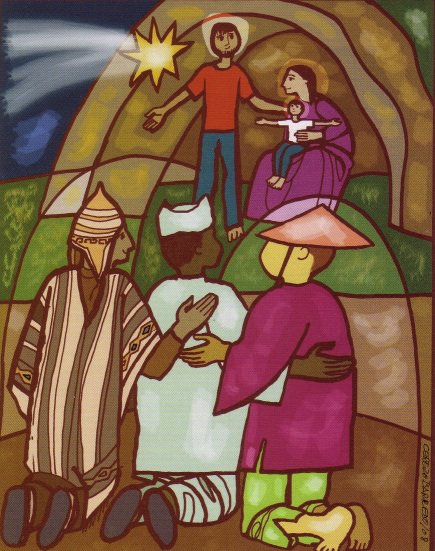
God’s entrance into the world was not overwhelming. It occurred at the margins of official history, outside the city, in the middle of the darkest night, in an animal shed. Nothing was known either in Rome, the capital of the empire, or in Jerusalem, the religious center of the People of Israel. Almost no one noticed: only those with a simple heart, such as the pastors of Bethlehem. They came to the shed where the Divine Child was shivering from the cold.

The Nativity offers us the key to deciphering some of the most inscrutable mysteries of our afflicted existence. Human beings have always questioned others and themselves: why is our existence so fragile? Why all the humiliation and the suffering? And God was silent. But in the Nativity an answer is found: God made Himself as fragile as we are. God humiliated himself and suffered as all human beings suffer. This was God’s answer: not in words but with a gesture of identification. We are no longer alone in our immense loneliness. God is with us. His name is Jesus.

The Nativity also gives us the key to the meaning of being human. We are an unfinished project. Only the Infinite can realize our full humanity. And it so happened that the Infinite became human so that the human could realize his Infinite project. The Infinite became a human being so that the human being could become Infinite.

To finish, nothing is more moving than these verses about the Child Jesus by the great Portuguese poet Fernando Pessoa:

He is the Eternal Child, the God we were missing.

He is so human that it is natural.

He is the divinity that smiles and plays.

Because of that I know with all certainty

That He is the true Child Jesus.

He is a child so human that He is divine.

We get along so well, the two of us,

In the company of everything,

That we never think of one in the other.

But we live the two of us together,

With an intimate agreement,

Like the right hand and the left hand.

When I die, Child of mine,

Let me be a child, the smallest one.

Take me in your arms and carry to your home.

Undress my tired and human being.

And lay me in your bed.

And if I wake, tell me stories,

That I may go back to sleep.

And let me play with your dreams,

Until I am born one day

You know which one it is.

Merry Christmas to all, men and women. Let’s trust: there is a Star, such as the star of Bethlehem, that illuminates our path no matter how dark it may be. Even if I do not know the path, Child Jesus, You know it; and You know it very well.

Leonardo Boff Eco-Theologian-Philosopher Earthcharter Commission

Free translation from the Spanish
Done at REFUGIO DEL RIO GRANDE, Texas, EE.UU.