La realidad puede ser peor de lo que imaginamos

Estamos viviendo momentos dramáticos de la historia humana. Hemos pasado los últimos 10 mil años, la era del holoceno, con relativa calma, y con un clima medio de 15 grados centígrados. Todo empezó a cambiar a partir del siglo XVIII con la revolución industrial y energética. La concentración de CO2, responsable principal de los disturbios climáticos, empezó a dispararse. En 1950 alcanzó las 300 ppm, en 2015 superó las 400 ppm y en la actualidad se acerca a las 420 ppm.

Dicen los especialistas que el nivel de CO2 en la atmósfera, potenciado por la entrada del metano producido por el deshielo de los cascos polares y del permafrost (regiones heladas que van de Canadá hasta los confines de Siberia), que es varias veces más dañino que el CO2, ya es el mayor, por lo menos de los últimos 3 millones de años. Se teme seriamente que plagas congeladas hace muchos miles de años, una vez descongeladas puedan afectar a nuestro sistema inmunológico, que no sería inmune a ellas, acabando por destruir muchas vidas.

El calentamiento sigue creciendo y provocando la subida del nivel del mar, la acidificación de las aguas oceánicas, la erosión de la biodiversidad, la contaminación del aire y de los suelos, la deforestación, la aparición de eventos extremos y la entrada de una variada gama variada de virus dañinos para la vida humana, como el Covid-19. La última COP26 realizada en Glasgow en 2021 activó la alarma: si no hacemos nada a partir de ahora, lentamente llegaremos a 2030 con un aumento de 1,5 grados centígrados o más. Entonces sucederían grandes catástrofes socioecológicas. Se habla de una “emergencia planetaria” e incluso de un “Armagedón ecológico” que devastarían gran parte de la vida tal como la conocemos. Sería consecuencia de la nueva era geológica del antropoceno, quizá del necroceno mismo.

¿Alguien se preocupa con este escenario inquietante y amenazador? Casi nadie. Se vive en la inconsciencia como en los tiempos de Noé. Como nadie sabe cuándo ni cómo vendrá el “diluvio”, todos se entregan a los negocios as usual, ansiando la vuelta a la antigua normalidad, que es justamente la que está produciendo la tragedia global del coronavirus. Pero más grave aún es la constatación de que no se evidencia una voluntad colectiva ni en los jefes de estado, ni en la sociedad mundial, de alertar sobre las graves consecuencias para nuestras vidas, para la vida de la naturaleza y para el destino de nuestra civilización. La  cuestión climática no entra en el radar de las políticas públicas o lo hace en los últimos lugares. Sin embargo, creemos que en pocos años, será la cuestión de las cuestiones, cuando por el exceso de calor grandes regiones se vuelvan inhabitables, las cosechas se frustren y millones de emigrantes climáticos y famélicos pongan en peligro la estabilidad de las naciones.

Pocos son los profetas que claman en el desierto; son considerados apocalípticos y caballeros de la triste noticia. Pero los que superaron esta ceguera sienten el deber ético y moral de despertar las conciencias y preparar a la humanidad para lo peor.

Debido a la irresponsabilidad de los CEOs de las grandes corporaciones, a la inercia de los jefes de estado, a la negligencia de la sociedad, a la indiferencia de los distintos saberes y movimientos (con excepción de algunos como Greenpeace, MST, Greta Thunberg y otros) en suscitar una conciencia colectiva, podremos conocer una realidad peor de lo que imaginamos. Los eventos que estamos sufriendo planetariamente con el coronavirus, las grandes inundaciones en Bahía, en Minas Gerais, en Tocantins, junto con las duras sequías en el sur del país, sin hablar de los eventos extremos en Estados Unidos, en Europa y el tsunami asiático podrán sacarnos de la alienación y mostrarnos realmente que el futuro que nos espera podrá ser peor de lo que pensamos.

¿Tenemos la posibilidad de retrasar el fin del mundo, en la expresión del líder indígena, Ailton Krenak? Podemos. Hagamos un ejercicio mental sobre nuestro tiempo dentro del gran proceso cosmogénico. Si reducimos la edad del universo, sus 13.700 millones de años, a un año, la primera singularidad, el Big Bang, habría ocurrido el día primero de enero. La vida, sólo el 2 octubre. Nuestro antepasado el homo sapiens, el día 31 de diciembre a las  11 horas y 53 minutos. Nuestra historia documentada, en los últimos diez segundos antes de medianoche. ¿Y nosotros? En una fracción de segundo antes de la medianoche (son los cálculos del físico y cosmólogo Brian Swimme).

Somos casi nada. Sin embargo, a través de nosotros la Tierra toma conciencia y con nuestros ojos ve todo el universo. Consideremos el coronavirus: tan minúsculo que es invisible y qué estragos está haciendo en la humanidad. Semejantemente nosotros somos casi un cero ante el Infinito. Pero cargamos la conciencia y la inteligencia de Todo lo que nos es dado conocer. Seguramente, por más irresponsables que seamos, somos importantes para el conjunto del universo conocido y creemos que no vamos a desaparecer de la faz de la Tierra. Viviremos y brillaremos.

Para eso son urgentes dos cosas: la primera, crear un lazo afectivo profundo con la naturaleza y con la Tierra. Amarlas y cuidarlas. La segunda, que vivamos una íntima comunión con ellas. La comunión es más que un concepto teológico fundamental. Es un dato de la realidad más profunda: todo está en comunión con todo pues todos estamos inter-retro-relacionados. Internalizando esta comunión podemos sentirnos hermanos y hermanas de todas las cosas al estilo de San Francisco de Asís. Y comportarnos así. Es el comportamiento que se nos exige ahora. Él podrá salvar la vida y salvarnos también a todos nosotros: el afecto y la comunión.

*Leonardo Boff ha escrito: Habitar la Tierra: ¿cuál es el camino para la fraternidad universal?, Vozes 2022; Cuidar la Tierra-salvar la vida: cómo escapar del fin del mundo, Record 2010.

Traducción de Mª José Gavito Milano
Will Capital’s “iron cage” produce “a polar night, icy, dark and arduous”?

          Leonardo Boff

We are still in 2021, a year that did not end because Covid-19 canceled the count of time to continue its lethal work. The 2022 could not, for now, be inaugurated. The fact is that the virus has brought all powers to their knees, especially the militarists, as their arsenal of death has become totally ineffective. However, the genius of capitalism, apropos of the pandemic, made the transnationalized capitalist class restructure itself through the Great Reset, expanding the recent digital economy through the integration of the giants: Microsoft, Facebook, Apple, Amazon , Google, Zoom and others with the military-industrial-security complex. Such an event represents the formation of an immense power, never before seen.

Note that this is an economic power of a capitalist nature and that, therefore, it fulfills its essential purpose, that of maximizing profits in an unlimited way, without regard to exploiting human beings and nature. Accumulation is not a means to a good life, but an end in itself, that is, accumulation for the sake of accumulation, which is irrational. The consequence of this radicalization of capitalism confirms what a sociologist at the University of California at Santa Barbara, William I. Robinson, in a recent article, well observed (ALAI 12/20/2021): “As the world gets rid of pandemic, there will be more inequality, conflicts, militarism and authoritarianism and to the same extent social upheavals and civil conflicts will increase; ruling groups will strive to expand the global police state to contain mass malcontents from below”.

Indeed, artificial intelligence with its billions and billions of algorithms will be used to control each person and the entire society. Where will this brutal power take humanity? Knowing the inexorable logic of the capitalist system, Max Weber, one of those who best analyzed it critically, just before he died, asserted: “What awaits us is not the flowering of autumn, but a polar night, icy, dark and arduous. (Le Savant et le Politique, Paris 1990, p. 194).

 He coined the strong expression that strikes at the heart of capitalism: it is an “iron cage” (Stahlartes Gehäuse) that cannot break and, therefore, can lead us to a great catastrophe (cf. the pertinent analysis by M.Löwy , La jaula de hierro: Max Weber and the Weberian Marxism, Mexico 2017). This opinion is shared by great names such as Thomas Man, Oswald Spengler, Ferdinand Tönnies, Eric Hobsbown, among others. Several world-society models are being discussed for the post-pandemic period.

The most important ones, besides the Great Reset of the billiards, are: green capitalism, ecosocialism, the bien viver and coexistence of the Andeans, biocivilization, of various groups and of Pope Francis among others.

This is not the place to detail such projects, which I did in the book Cvid-19: Mother Earth counterattacks Humanity (Voices 2020). I would just say: either we change the paradigm of production, consumption, coexistence and, especially, our relationship with nature, with respect and care, feeling that we are part of it and not about it as owners and masters, or else to fulfill ourselves.

Max Weber’s prognosis will be: from 2030 to 2050 at most, we will experience an ecological-social armageddon that is extremely harmful to life and to the Earth. In this sense, my feeling for the world tells me that whoever is going to destroy the order of capital, with its economy, politics and culture, would be no moment or school of critical thought.

 It would be Earth itself, a limited planet that no longer supports a project of unlimited growth. The visible climate change, object of discussion and decision-making (practically none) of the last UN COPs, the growing depletion of natural goods and services, fundamental for life (The Earth Overshoot) and the threat of disruption of the main nine barriers to development that cannot be broken at the price of civilization’s collapse.

A significant number of climate experts say we are too late. With the already accumulated greenhouse gases we will not be able to contain the catastrophe, only, with science and technology, to lessen its disastrous effects. But the great irreversible crisis will come. That’s why they became skeptics and even technofatalists. Are we resigned pessimists or, in Nietzsche’s sense, adherents of “heroic resignation”? I believe, as a pre-Socratic said: we must expect the unexpected, because if we don’t expect it, when it comes, we won’t notice it. The unexpected can occur, within the quantum perspective: the current suffering because of the systemic crisis will not be in vain; he is accumulating benevolent energies which, upon reaching a certain level of complexity and accumulation, will make a leap to another higher order with a new horizon of hope for life and for the living planet, Gaia, Mother Earth. Paulo Freire coined the expression to hope: not to wait for the situation to improve one day, but to create the conditions so that hope is not empty, but that, with our commitment, we make it effective. I believe that this leap, with our participation, could occur and would be within the possibilities of the history of the universe and the Earth: from the current destructive chaos, we can move to a generative chaos of a new way of being and inhabiting planet Earth. This is what I believe and hope, reinforced by the word of Revelation that says: “God created all things out of love because he is the passionate lover of life” (Wisdom 11:26). He will not allow us to end this tragically. We will still live in the benevolent light of the sun.

 Leonardo Boff, ecotheologist, philosopher and writer. Wrote The painful birth of Mother Earth: a society of fraternity without borders and social friendship, Vozes 2021; Inhabiting the Earth: What is the path to universal brotherhood? Voices 2121.

s the formation of an immense power, never before seen.

Note that this is an economic power of a capitalist nature and that, therefore, it fulfills its essential purpose, that of maximizing profits in an unlimited way, without regard to exploiting human beings and nature. Accumulation is not a means to a good life, but an end in itself, that is, accumulation for the sake of accumulation, which is irrational. The consequence of this radicalization of capitalism confirms what a sociologist at the University of California at Santa Barbara, William I. Robinson, in a recent article, well observed (ALAI 12/20/2021): “As the world gets rid of pandemic, there will be more inequality, conflicts, militarism and authoritarianism and to the same extent social upheavals and civil conflicts will increase; ruling groups will strive to expand the global police state to contain mass malcontents from below”.

Indeed, artificial intelligence with its billions and billions of algorithms will be used to control each person and the entire society. Where will this brutal power take humanity? Knowing the inexorable logic of the capitalist system, Max Weber, one of those who best analyzed it critically, just before he died, asserted: “What awaits us is not the flowering of autumn, but a polar night, icy, dark and arduous. (Le Savant et le Politique, Paris 1990, p. 194).

 He coined the strong expression that strikes at the heart of capitalism: it is an “iron cage” (Stahlartes Gehäuse) that cannot break and, therefore, can lead us to a great catastrophe (cf. the pertinent analysis by M.Löwy , La jaula de hierro: Max Weber and the Weberian Marxism, Mexico 2017). This opinion is shared by great names such as Thomas Man, Oswald Spengler, Ferdinand Tönnies, Eric Hobsbown, among others. Several world-society models are being discussed for the post-pandemic period.

The most important ones, besides the Great Reset of the billiards, are: green capitalism, ecosocialism, the bien viver and coexistence of the Andeans, biocivilization, of various groups and of Pope Francis among others.

This is not the place to detail such projects, which I did in the book Cvid-19: Mother Earth counterattacks Humanity (Voices 2020). I would just say: either we change the paradigm of production, consumption, coexistence and, especially, our relationship with nature, with respect and care, feeling that we are part of it and not about it as owners and masters, or else to fulfill ourselves.

Max Weber’s prognosis will be: from 2030 to 2050 at most, we will experience an ecological-social armageddon that is extremely harmful to life and to the Earth. In this sense, my feeling for the world tells me that whoever is going to destroy the order of capital, with its economy, politics and culture, would be no moment or school of critical thought.

 It would be Earth itself, a limited planet that no longer supports a project of unlimited growth. The visible climate change, object of discussion and decision-making (practically none) of the last UN COPs, the growing depletion of natural goods and services, fundamental for life (The Earth Overshoot) and the threat of disruption of the main nine barriers to development that cannot be broken at the price of civilization’s collapse.

A significant number of climate experts say we are too late. With the already accumulated greenhouse gases we will not be able to contain the catastrophe, only, with science and technology, to lessen its disastrous effects. But the great irreversible crisis will come. That’s why they became skeptics and even technofatalists. Are we resigned pessimists or, in Nietzsche’s sense, adherents of “heroic resignation”? I believe, as a pre-Socratic said: we must expect the unexpected, because if we don’t expect it, when it comes, we won’t notice it. The unexpected can occur, within the quantum perspective: the current suffering because of the systemic crisis will not be in vain; he is accumulating benevolent energies which, upon reaching a certain level of complexity and accumulation, will make a leap to another higher order with a new horizon of hope for life and for the living planet, Gaia, Mother Earth. Paulo Freire coined the expression to hope: not to wait for the situation to improve one day, but to create the conditions so that hope is not empty, but that, with our commitment, we make it effective. I believe that this leap, with our participation, could occur and would be within the possibilities of the history of the universe and the Earth: from the current destructive chaos, we can move to a generative chaos of a new way of being and inhabiting planet Earth. This is what I believe and hope, reinforced by the word of Revelation that says: “God created all things out of love because he is the passionate lover of life” (Wisdom 11:26). He will not allow us to end this tragically. We will still live in the benevolent light of the sun.

 Leonardo Boff, ecotheologist, philosopher and writer. Wrote The painful birth of Mother Earth: a society of fraternity without borders and social friendship, Vozes 2021; Inhabiting the Earth: What is the path to universal brotherhood? Voices 2121.

Habitar la Tierra:¿Cuál es el camino para la fraternidad universal?

Leonardo Boff*

Estamos ante una triste constatación: el tipo de mundo en el que vivimos es todo menos fraternal. Lo que predomina es el poder, que desde el inicio establece una división entre quien tiene poder y quien no tiene poder. Se trata del poder-dominación, político, económico, ideológico, mediático, también familiar, y otros. De esta división nacen toda suerte de desigualdades: unos  imponiéndose a los demás, la mayoría situada en el piso de abajo y unos pocos en el piso de arriba.

La desigualdad significa injusticia social, que éticamente es inaceptable. Para las personas de fe, la injusticia social es un pecado contra el Creador porque le ofende a Él y a sus hijos e hijas. Por lo tanto, estamos en una situación que no nos agrada a nosotros y tampoco agrada a Dios.

Es intensa la búsqueda humana de una sociedad libre, igualitaria, justa y fraterna. En nombre de ella se hicieron las grandes revoluciones, siempre derrotadas, pero nunca vencidas definitivamente, pues el anhelo humano de libertad, igualdad y fraternidad es imperecedero. Siempre habrá personas y movimientos sociales que mantendrán vivo ese sueño y tratarán de concretarlo en la historia.

Son muchos los motivos que fundan la fraternidad. En primer lugar, todos somos portadores de la misma humanidad, poco importa el origen, el color de la piel, la religión y la visión de mundo que tengamos. Todos tenemos el mismo código genético de base, presente en todos los seres vivos: los veinte aminoácidos y las cuatro bases nitrogenadas. Dicho en lenguaje pedestre: estamos construidos de 20 ladrillos diferentes y cuatro tipos de cemento. Los ladrillos combinados y amalgamados con los varios tipos de cemento producen la biodiversidad. Lo cual quiere decir que existe un lazo de fraternidad real entre todos los seres vivos y especialmente entre los humanos. La fraternidad es universal,  incluida la naturaleza.

Otra razón de la fraternidad es el hecho de que todos los seres, también los humanos, tenemos algo en común: venimos del barro de la Tierra. Homo, ser humano, procede de humus, tierra buena y fértil. De la misma forma, nuestro antepasado bíblico Adán, se deriva de adamah, que quiere decir: tierra arable y fecunda. De ese barro el Creador nos sacó y moldeó como sus criaturas, todos hermanados entre sí.

Estas raíces comunes nos invitan a vivir en fraternidad universal e ilimitada. Este fue el sueño de Jesús, que advirtió que nadie sea llamado maestro porque todos somos hermanos y hermanas. La fraternidad sin fronteras fue la búsqueda ardiente de San Francisco de Asís, que llamaba a todos los seres de la naturaleza con el dulce nombre de hermanos y hermanas. Fue a conversar con el sultán musulmán en Egipto porque quería una fraternidad universal que implicaba incluir a cristianos y no cristianos. Es el gran sueño de Francisco de Roma, el Papa actual, que ha escrito una valiente encíclica Fratelli tutti, “todos hermanos y hermanas”, como respuesta a un mundo globalizado que crea socios, pero no hermanos y hermanas, que nos hace virtualmente próximos, pero realmente distantes por causa de la riqueza de algunos a costa de la pobreza de muchos.

Dentro del mundo actual, fundado en el poder-dominación sobre personas, sobre pueblos y sobre la naturaleza, la fraternidad  universal no tiene condiciones para realizarse. Sin embargo, si bien no parece viable, ella puede ser una actitud permanente, un modo de ser, un espíritu que impregne todas las relaciones entre las personas, y también las institucionales, de participación igualitaria y cooperativa. Todo eso a condición de renunciar al poder-dominación y de tener humildad, no como una virtud ascética, sino como un mojar nuestras raíces en el mismo humus de donde la naturaleza y nosotros aseguramos nuestra existencia, viendo en cada ser y en cada persona, un hermano y una hermana, con el mismo origen y el mismo destino. Entre hermanos y hermanas hay amor, cuidado y un sentimiento profundo de pertenencia.

Ante las graves amenazas que pesan sobre la Madre Tierra superexplotada y la ruptura del tejido social de las naciones, la fraternidad sin fronteras, como un nuevo tipo de presencia en el mundo, nos podrá salvar. Este libro Habitar la Tierra: cuál es el camino para la fraternidad universal quiere traer a debate la urgencia del amor social y de la fraternidad universal, por lo menos como un modo de ser tierno y despojado de la voluntad de poder-dominación, creando un lazo de afecto y de cuidado entre todos los seres del mundo natural y del mundo humano.

*Leonardo Boff, 1938, se doctoró en teología sistemática en Múnich. Fue 22 años profesor de teología del Instituto Teológico Franciscano de Petrópolis. Posteriormente se doctoró en filosofía en la UERJ y fue profesor de Ética, Filosofía de la Religión y Ecología Filosófica en la Universidad de Río de Janeiro. Fue profesor visitante en varias universidades europeas. Fue muchos años editor religioso de la Editorial Vozes y coordinó la publicación de la obra completa de C.G.Jung en portugués. Recibió el premio Nobel alternativo de la Paz 2001 del Parlamento sueco. Es doctor honoris causa por varias universidades. Ha escrito cerca de cien libros en las áreas de teología, filosofía, espiritualidad y ecología.

Traducción de Mª José Gavito Milano

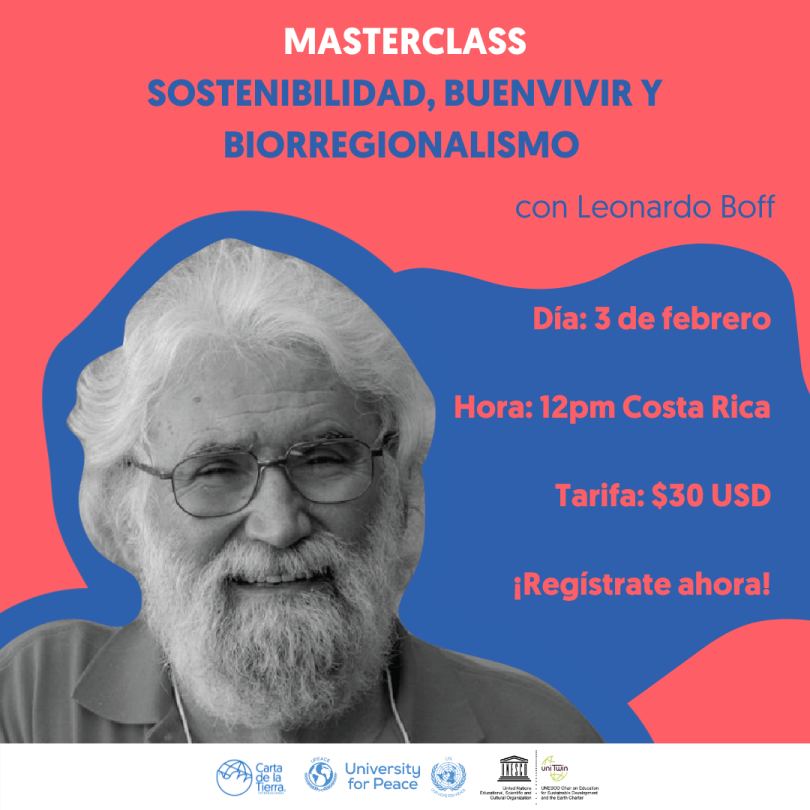
Sostenibilidad, Buenvivir y Biorregionalismo – con Leonardo Boff

Convido as pessoas para esta dupla aula sobre a discussão atual acerca da sustentabilidade do planeta, da vida, da nossa civilização e também da economia. Serão apresentadas as várias alternativas.

Será falada em espanhol sem tradução para português.

Na Costa Rica será às 12 horas p.m que corresponde no Brasil às 15 horas p.m. Creio que vale a pena se confrontar com um dos temas mais decisivos para o nosso futuro, inclusive para o Brasil.

É uma promoção da Carta da Terra Internacional, cujo escritório central se encontra em São José da Costa Rica, sendo a secretária geral uma brasileira, especialista no tema, Mirian Vilela.

Leonardo Boff, membro da Comissão Internacional da Carta da Terra, oficializada em 2003 pela UNESCO mas com grupos espalhados por todo o mundo.