De quanta terra precisa um homem?

Numa roda, cercado de rústicos peões de sua fazenda Yasnaya Polyana, Léon Tolstói (1828-1910) o grande escritor russo, contou-lhes a seguinte estória que eu me permito resumir para exemplificar como funciona a cabeça de um capitalista.

“Havia um camponês pobre mas muito desejoso de possuir mais a mais terra para cultivar e ficar rico. Pensou: “Vou fazer um pacto com o diabo. Este vai me dar sorte”, disse ele à mulher, que torceu o nariz e advertiu-o: “Meu marido, cuidado com o diabo, nunca sai coisa boa fazendo um pacto com ele; essa sua vontade de ficar rico, vai ainda pô-lo a perder”.

Mas, por insistência do marido, resolveu acompanhá-lo.Com tal que partiram, levando poucos pertences.

Souberam que longe daí havia um grupo de ciganos que vendiam terras baratas. Para aquelas paragens rumou o casal. Chegando l, eis que o diabo já estava de pé, todo apessoado, dando ares de um influente mercador de terras. O camponês e sua mulher cumprimentaram educadamente os ciganos. Quando iam expressar seu desejo de adquirir terras deles, o diabo, sem cerimônias, logo se antecipou e disse:

“Bom senhor, vejo que veio de longe e é tomado por um grande desejo de  fazer  fortuna. Tenho uma excelente proposta para você, melhor do que aquela dos ciganos. Faço-lhe a seguinte proposta: você deixa uma quantia razoável de dinheiro  numa bolsa aqui onde estou de pé. Se você percorrer um território durante o tempo de um dia, do nascer ao pôr do sol, e estiver de volta antes de o sol se pôr, toda a terra percorrida será sua. Caso contrário perderá as terras percorridas e o dinheiro da bolsa”.

Os olhos do camponês, ávido por riqueza, brilharam de emoção e disse:

“Acho uma excelente proposta. Tenho pernas fortes e aceito. Amanhã bem cedo, ao nascer do sol, ponho-me a correr e todo o território que minhas pernas puderem alcançar, será meu”.

 O diabo, sempre malicioso, sorriu todo faceiro.

De fato, bem cedo, mal o sol rompeu a fímbria do horizonte, o camponês, tomado de cobiça, se pôs a correr. Correu e correu muito. Pulou cercas, atravessou riachos e, não contente, sequer parou para descansar. Via diante de si uma ridente planície verde e logo pensou: “aqui vou plantar trigo em abundância”. Olhando à esquerda, se descortinava um vale muito plano e pensou: “aqui posso fazer toda uma plantação de linho para dar e vender”.

Subiu, ofegante, uma pequena colina e eis, que lá em baixo se abria um campo de terra virgem. Logo pensou: “quero também aquela terra. Aí vou criar gado e ovelhas e vou encher as burras com muito dinheiro.

E assim percorreu muitos quilômetros, não satisfeito com o que tinha conquistado, pois os lugares que via, eram atraentes e alimentavam ainda mais seu desejo incontido de também possui-los.

De repente olhou para o céu e se deu conta de que o sol estava se pondo atrás da montanha. Disse de si para consigo mesmo:

“Não há tempo a perder. Tenho que voltar correndo, senão perco todos os terrenos percorridos e, por cima ainda, o dinheiro. “Um dia de dor, uma vida de amor”, pensou como dizia seu avô.

Pôs-se a correr com uma velocidade espantosa para suas pernas cansadas. Mas tinha que correr sem reparar os limites dos músculos retesados. Sempre olhava a posição do sol, já perto do horizonte, enorme e vermelho como sangue. Mas não se havia ainda posto totalmente. Mesmo cansadíssimo, corria mais e mais e já nem sentia as pernas. Pesaroso pensou: “talvez abarquei demais terras e posso perder tudo. Mas vamos em frente”.

Vendo, porém, ao longe o diabo, solenemente, de pé e ao seu lado a sacola de dinheiro, recobrou mais o ânimo, certo de que iria chegar antes do pôr do sol. Reuniu todas as energias que tinha e fez um derradeiro esforço. Pulou uma cerca, atravessou um riacho e corria, quase voando. Não muito longe da chegada, atirou-se para frente, quase perdendo o equilíbrio. Refeito, deu ainda alguns passos longos.

Foi então que, extenuado e já sem nenhuma força, se estatelou no chão. E morreu. A boca sangrava e todo o corpo estava coberto de arranhões e de suor.

 O diabo, maldosamente, apenas sorriu e tomou para si a bolsa de dinheiro. Indiferente ao destino do morto, deu-se ainda ao trabalho de fazer uma cova com o tamanho do camponês e ajeitou-o lá dentro. Eram apenas sete palmos de terra, a parte menor que lhe cabia de todos os terrenos andados. Não precisava de mais do que isso. A mulher, petrificada, assistia a tudo, chorando copiosamente”.

Esse conto nos faz lembrar o poeta pernambucano João Cabral de Melo Neto (1920-1999) que nos deixou a comovente obra Morte e Vida Severina (1995). No funeral do lavrador diz:

Esta cova em que estás, com palmos medida, é a conta menor que tiraste em vida; é a parte que te cabe deste latifúndio”.

A mulher do camponês estava certa em sua advertência: “Cuidado com o diabo, pois, te estimula a ter mais e mais e, por fim, acaba contigo e toma todo o teu dinheiro”. É a lógica do capital. Nele vivemos e sofremos. Avançando sobre as florestas ele nos trouxe o Covid-10. Como nos livraremos dele?

Leonardo Boff é escritor e escreveu:Habitar a Terra:qual o caminho para a fraternidade universal? Vozes 2021.

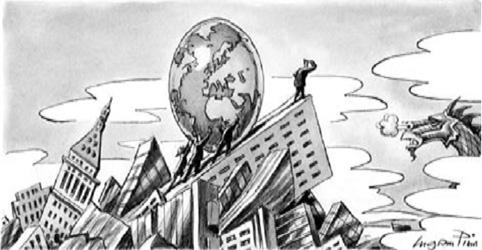
The iron cage” of Capital

The unexpected may occur, within the quantum perspective assumed by the new cosmology: the current suffering due to the systemic crisis will not be in vain; it is accumulating benign energies that will make a leap to another, higher order.

04/01/2022

Versión para impresión

crisis_capitalismo.jpgImagen: tacnacomunitaria.blogspot.com A+A

We are still in 2021, a year that did not end because Covid-19 cancelled the counting of time by continuing its lethal work. 2022 could not, for now, be inaugurated. The fact is that the virus has brought all powers, especially the militaristic ones, to their knees, as their arsenal of death has become totally ineffective.

However, the genius of capitalism, regarding the pandemic, has caused the transnationalized capitalist class to restructure itself through the Great Reset, expanding the new digital economy through the integration of the giants: Microsoft, Facebook, Apple, Amazon, Google, Zoom, and others with the military-industrial-security complex.

Such an event represents the formation of an immense power, the like of which has never been seen before. Let us note that this is an economic power of a capitalist nature, and that it therefore realizes its essential purpose, that of maximizing profits in an unlimited way, exploiting, without consideration, human beings and nature. Accumulation is not a means to a good life but an end in itself, that is to say, accumulation for accumulation’s sake, which is irrational.

The consequence of this radicalization of capitalism confirms what a sociologist from the University of California at Santa Barbara, William I. Robinson, in a recent article, has well observed (ALAI 20/12/2021): “In the aftermath of the pandemic, there will be more inequality, conflict, militarism, and authoritarianism as social upheaval and civil strife escalate. The ruling groups will turn to expanding the global police state to contain mass discontent from below”. In effect, artificial intelligence with its billions upon billions of algorithms will be used to control each person and the entire society. Where will this brutal power take humanity?

Knowing the inexorable logic of the capitalist system, Max Weber, one of those who best analyzed it critically, shortly before his death, asserted: “What awaits us is not the blooming of autumn, but a polar, icy, dark and arduous night (Le Savant et le Politique, Paris 1990, p. 194). He coined a strong expression that strikes at the heart of capitalism: it is an “iron cage” (Stahlartes Gehäuse) that cannot be broken and, therefore, can lead us to a great catastrophe (cf. the pertinent analysis of M. Löwy, La jaula de hierro: Max Weber y el marxismo weberiana, México 2017). This opinion is shared by great names such as Thomas Mann, Oswald Spengler, Ferdinand Tönnies, Eric Hobsbawm, among others.

Various world-society models are being discussed for the post-pandemic. The most important ones, besides the Great Reset of the billionaires, are: green capitalism, ecosocialism, the Andean buen vivir and convivir, biocivilization, of various groups and Pope Francis, among others. It is not up to me here to detail such projects, which I have done in the book Covid-19: A Mãe Terra contra-ataca a Humanidade (Vozes 2020). I would only say: either we change the paradigm of production, consumption, coexistence, and especially the relationship with nature, with respect and care, feeling part of it and not over it as owners and lords, or else Max Weber’s prognosis will come true: we may from 2030 to at most 2050, experience an ecological-social Armageddon extremely harmful to life and to the Earth.

In this sense, my feeling of the world tells me that the one who will destroy the order of capital, with its economy, politics, and culture, would not be any mill or school of critical thinking. It would be the Earth itself, a limited planet that can no longer support a project of unlimited growth. The visible climate change, object of discussion and decision making (practically none) of the last UN COPs, the increasing depletion of natural goods and services, fundamental for life (The Earth Overshoot) and the threat of breaking the main nine boundaries of development that cannot be broken at the price of the collapse of civilization, are some indicators of an imminent tragedy.

A significant number of climate experts say that we are too late. With the already accumulated greenhouse gases we will not be able to contain the catastrophe, only, with science and technology, to lessen its disastrous effects. But the great irreversible crisis will come. That is why they have become skeptics and even techno-fatalists.

Are we resigned pessimists or, in Nietzsche’s sense, supporters of “heroic resignation”? I think, as a pre-Socratic said: we should expect the unexpected, because if we don’t expect it, when it comes, we will not perceive it. The unexpected may occur, within the quantum perspective assumed by the new cosmology: the current suffering due to the systemic crisis will not be in vain; it is accumulating benign energies that, upon reaching a certain level of complexity and accumulation, will make a leap to another, higher order with a new horizon of hope for life and for the living planet, Gaia, Mother Earth. Paulo Freire coined the expression to hope: not to keep hoping that one day the situation will improve, but to create the conditions for hope not to be empty, but to make it effective through our efforts.

I believe that this leap, with our participation, specially the victims of the exploitation of capitalism, can occur and would be within the possibilities of the history of the universe and the Earth: from the current destructive chaos, we can move on to a generative chaos of a new way of being and inhabiting planet Earth.

This is what I believe and hope for, reinforced by the word of Revelation that states: “God created all things out of love because He is the passionate lover of life” (Wisdom 11,26). We will still live under the benevolent light of the sun.

– Leonardo Boff, ecotheologist, philosopher, and writer, has written The painful birth of Mother Earth: a society of fraternity without bor